Resonant Capital Advisors, LLC (“Resonant”) is an SEC-registered investment advisor headquartered in Madison, Wisconsin. Information presented is for educational purposes only and does not intend to make an offer or solicitation for the sale or purchase of any specific securities, investments, or investment strategies. Accordingly, the information presented should not be construed as investment, legal, tax or accounting advice related to individual situations. Resonant and its advisors are not tax experts. Because tax laws and regulations change frequently, and their application can vary widely based on the specific facts and circumstances involved, you should consult with a qualified tax professional familiar with your personal tax situation before implementing any strategy discussed herein. Similarly, always consult a qualified financial advisor or attorney regarding your specific financial and legal situation before implementing any strategy. Investing involves risk, including the risk of loss, and past performance is not indicative of future performance.

Overview
Retirement savings plans are long-term financial tools designed to help individuals accumulate funds for retirement. Given the wide array of available plans, the IRS classifies them into two main categories: qualified and non-qualified.
Qualified vs. Non-Qualified Plans
Qualified employer-sponsored retirement plans differ from non-qualified plans because they must comply with specific IRS and ERISA requirements to secure certain tax benefits. While these regulations provide important benefits, they can also increase the costs for employers sponsoring a qualified plan. The following summary highlights some key differences between qualified and non-qualified plans.
Qualified Plans
- Cannot discriminate in favor of select employees
- Funding needed by due date of return including extensions
- Immediate employer deduction and employee deferral of tax on earnings
- Increased costs arise from ACP/ADP testing and compliance with IRS reporting requirements.
- Examples include 401(k), 403(b), and pension plans
Non-Qualified Plans
- Can discriminate in favor of select employees
- Funding not required and/or informal
- Postponed employer deduction and possible employee deferral of tax
- Cost-effective with minimal reporting requirements
- Examples include IRAs and Personal Defined Benefit Plans
Employee Retirement Income Security Act (ERISA)
The Employee Retirement Income Security Act of 1974 (ERISA) is a federal law that establishes standards for most employer-sponsored retirement plans. Designed to safeguard employee interests, ERISA mandates transparency through reporting and disclosure requirements, sets minimum funding obligations, and enforces non-discrimination testing. Additionally, it places a fiduciary responsibility on plan administrators, ensuring they act in the best interests of participants.
Employer-Sponsored Retirement Plans
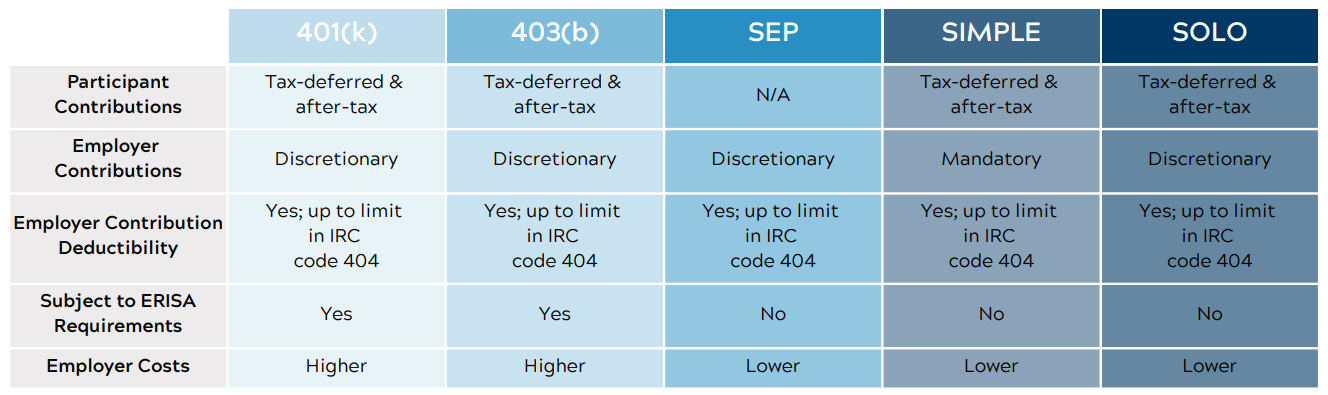
Employer-sponsored retirement plans differ in their taxability, flexibility, benefits, and ERISA eligibility. The table below compares the features of various core employer-sponsored retirement plans.
Individual Retirement Plans
Individual Retirement Accounts (IRA) are valuable savings tools for those with earned income, and aid in retirement preparation. Available in several types, including Traditional, Roth, SEP, and SIMPLE, each IRA offers unique benefits related to flexibility, tax advantages, and savings potential. This white paper will delve deeper into these benefits.
Traditional vs. Roth Savings
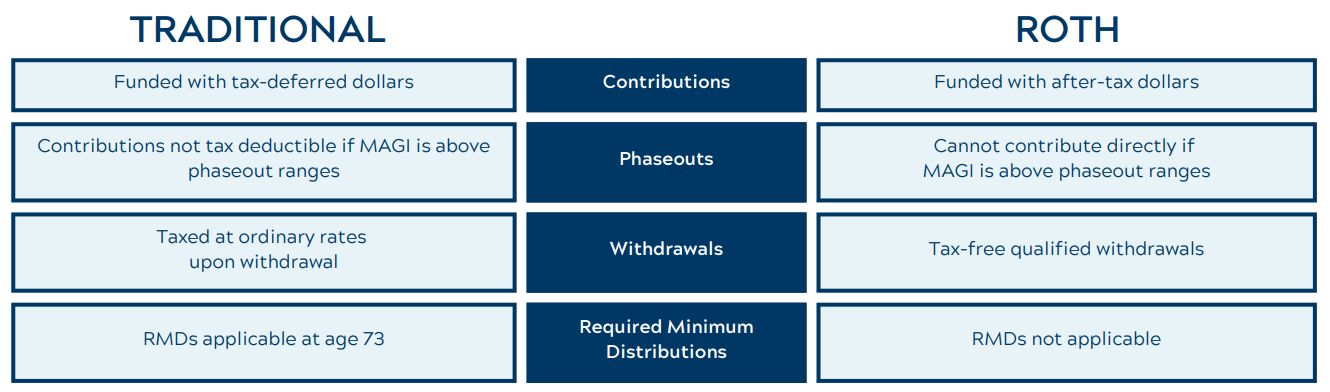
With legislation such as the SECURE Act 2.0 expanding Roth savings options, individuals with and without employer-sponsored retirement plans now have more opportunities to utilize these options. Accounts that permit Roth contributions include the 401(k), 403(b), 457(b), IRA, SEP, and SIMPLE plans. The information below highlights the primary differences between traditional and Roth savings options.
Personal Defined Benefit Plans
Personal defined benefit plans (PDB) are commonly used by self-employed individuals and small business owners to save for retirement. These plans are funded each year by employers with tax-deferred contributions and withdrawals are taxed as ordinary income. What makes PDBs advantageous are their high contribution limits, which are calculated by actuaries. Conversely, PDBs can be costly to maintain due to the expenses of actuarial services, annual funding, non-discrimination testing, and IRS reporting requirements.
Common Pitfalls
When planning for retirement, many individuals encounter pitfalls that can hinder their ability to achieve their retirement goals.
- Forfeiting Employer Matching by Reaching Contribution Limits Too Early
Most employer matches are calculated and funded each pay period. Individuals who reach their contribution limit early in the year may forfeit the employer match for the pay periods during in which they do not contribute. - Pursuing ‘Tax Diversification’ Through Traditional and Roth Accounts
To manage the uncertainty of future tax rates, individuals often contribute to both traditional and Roth accounts. This can reduce the benefits of each type of account since their tax advantages are inversely related. Essentially, the benefit gained from one account is offset by the drawback experienced in the other. - Utilizing Retirement Savings Only for the Employed Spouse
Couples with one non-working spouse can still save for retirement through a spousal traditional or Roth IRA. This allows both spouses to contribute to a retirement plan even if one is not employed. - Overlooking the Significance of Time
Time is your greatest asset for retirement savings. Starting early lets compound interest drive growth, improves risk management, and provides greater financial flexibility, laying a stronger foundation for your retirement.
Summary
Retirement plans vary widely, each offering distinct benefits and requirements. To ensure you choose the best option for your needs, it's important to consult with your financial advisor. By doing so, you can avoid common pitfalls and tailor your retirement strategy to best fit your personal circumstances.