Market leadership broadened in the second quarter, with mid- and small-cap stocks outperforming the S&P 500 — an encouraging sign that returns are no longer dependent on a handful of mega-cap names.
New Federal Reserve Chair Kevin Warsh abandoned the detailed forward guidance of the Powell era, a shift likely to bring more short-term volatility but healthier, data-driven markets.
AI investment is accelerating faster than the cash flows funding it, pushing the largest technology companies from self-funding into the debt markets. History suggests the biggest winners may be the companies that use AI best, not those spending the most to build it.
SpaceX's public debut opened a new physical frontier for investors, raising a familiar question from past buildouts: infrastructure success and investment success are not the same thing.
The Long View
Each day the never-ending news cycle competes for our attention. While such information influences short-term market behavior, it rarely defines long-term investment success in isolation.
Throughout history, the greatest periods of wealth creation have emerged from times of uncertainty. The construction of American railroads, the electrification of industry, the interstate highway system, the rise of the internet, and today's advances in artificial intelligence all required extraordinary commitments of capital long before markets fully recognized their economic benefits.
During the second quarter, market leadership broadened, and the confirmation of a new Federal Reserve Chairman ushered in a new chapter in U.S. monetary policy. At the same time, investment in artificial intelligence accelerated, and the commercial space industry reached another milestone. Individually, these developments may appear unrelated; collectively, they suggest we may be entering another period in which long-term innovation matters more than near-term volatility. This quarter we explore what these developments may be telling us, not simply about the last quarter, but about the investment landscape of the next decade.
Market Review
What is the market telling us?
The second quarter reminded investors that markets can advance through periods of uncertainty. Geopolitical conflict, rising energy prices, renewed inflation concerns, and higher interest rates dominated the headlines, yet the global economy remained resilient. Corporate investment in artificial intelligence continued at an unprecedented pace, reinforcing investors' confidence that long-term structural growth can coexist with periods of short-term uncertainty.
Source: YCharts
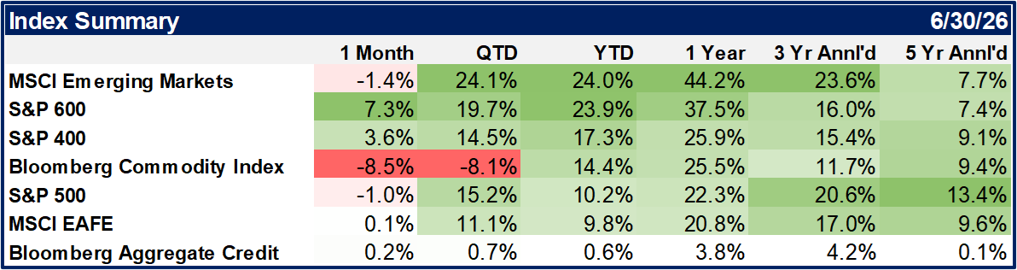
Markets reflected that resilience. The S&P 500 advanced 15.2% during the quarter, bringing its year-to-date return to 10.2%. More encouraging, however, was the continued broadening of market leadership. The S&P MidCap 400 and S&P SmallCap 600 gained 14.5% and 19.7%, respectively, during the quarter. At the midpoint of the year, both indexes had outperformed the S&P 500, with returns of 17.3% and 23.9%. After three years in which a relatively small group of mega-cap technology companies dominated market performance, broader participation is an encouraging sign that reinforces the long-term value of diversification.
International markets also delivered positive results. The MSCI EAFE Index returned 11.1% during the quarter and 9.8% year-to-date. Emerging markets led global performance, with the MSCI Emerging Markets Index advancing 24.1% during the quarter and 24.0% for the year. Continued investment in AI infrastructure, improving semiconductor supply chains, and steady economic activity across several developing economies helped support earnings and stock price returns.
While equity markets looked through much of the quarter's uncertainty, bond investors remained focused on inflation and interest rates. Rising oil prices, a leadership transition at the Federal Reserve, and persistent inflation expectations pushed Treasury yields higher. The U.S. 10-Year Treasury yield finished the quarter at 4.4% after briefly moving above 4.5% in mid-May.
Despite modest headwinds for existing bondholders, the Bloomberg Intermediate Government/Credit Index posted a small gain of 0.4%. At the same time, today's higher yields continue to benefit investors allocating new capital to fixed income. Municipal bonds also benefited from attractive tax-equivalent yields and strong credit fundamentals. Robust demand helped offset rising rates, allowing the Bloomberg Municipal 1–10 Year Blend Index to gain 1.3%.
Commodity markets, in contrast, paused after several years of exceptional performance. The Bloomberg Commodity Index returned -8.1% during the quarter but remained positive for the year with a return of 14.4%.
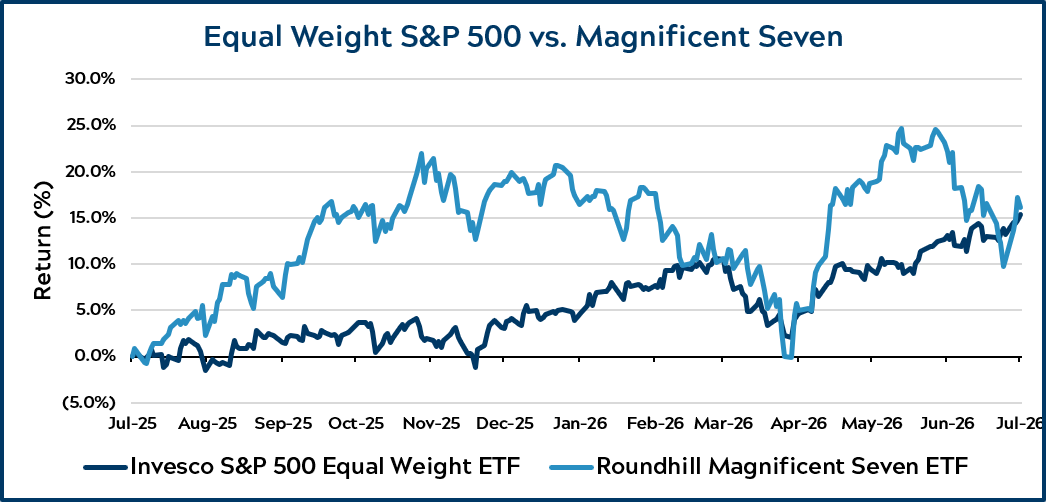
A welcome underlying message from the quarter was not the level of market returns, but the character of those returns. Improving market breadth, visualized in the chart below comparing an equal-weight S&P 500 to the Magnificent Seven, suggests investors are beginning to recognize opportunities beyond a narrow group of market leaders. Volatility is likely to remain part of today's investment landscape. Even so, steady economic fundamentals combined with continued investment in transformative technologies provide a favorable backdrop for disciplined, long-term investors.
Source: YCharts
A New Era at the Federal Reserve
How should investors interpret a new policy framework?
While geopolitical events dominated daily headlines, one of the quarter's most consequential developments may prove to be far less visible: the beginning of Kevin Warsh's tenure as Chair of the Federal Reserve. The June Federal Open Market Committee (FOMC) meeting was noteworthy not because of what the Federal Reserve did, but because of how it communicated. In our view, it marked the most significant shift in the Federal Reserve's communication strategy since the Global Financial Crisis.
As expected, the Federal Reserve left the federal funds rate unchanged at 3.50%–3.75%. What surprised investors was everything else. The Committee largely abandoned the forward guidance that has become a hallmark of monetary policy over the past decade, released a more hawkish set of economic projections than markets anticipated, and saw a meaningful increase in the number of FOMC participants projecting additional rate hikes later this year. The meeting concluded with a concise but unmistakable message: restoring and maintaining price stability remains the Committee's primary objective.
Chair Warsh (pictured left) has long questioned the value of extensive forward guidance. His philosophy appears to be that markets function more efficiently when investors respond to incoming economic data rather than to carefully scripted signals from policymakers. In his view, excessive
guidance can distort market pricing, encourage speculation about future policy decisions, and reduce the market's ability to incorporate new information objectively.
This represents a meaningful departure from the leadership of prior Chair Jerome Powell, during which the Federal Reserve frequently sought to prepare markets well in advance of policy changes in order to reduce volatility. Under Chair Warsh, investors should expect greater uncertainty surrounding each FOMC meeting and a renewed emphasis on economic data rather than on the Federal Reserve's interpretation of where policy may be headed.
Financial markets responded immediately. Although investors entered the June meeting expecting no change in interest rates and gradual policy easing later this year, they left with the realization that additional rate hikes remain a distinct possibility if inflation fails to moderate. The two-year Treasury yield rose approximately 16 basis points (0.16%) following the meeting, one of the largest post-FOMC moves in recent years.
For long-term investors, the implications extend well beyond a single meeting. A Federal Reserve that provides less guidance will likely result in greater short-term volatility around economic data releases and policy announcements. While that may create periods of uncertainty, it should also lead to markets that more accurately reflect underlying economic fundamentals rather than expectations shaped by central bank communication.
Understanding the data and not simply anticipating Federal Reserve action(s) may once again become one of the market's most valuable disciplines. For long-term investors, markets that reward careful analysis, disciplined valuation, and patience ultimately create better opportunities than markets driven primarily by speculation.
Beyond the AI Headlines
Who ultimately captures the value?
“You’re not going to lose your job to AI, but you’re going to lose your job to someone who uses AI.” - Jensen Huang, CEO of Nvidia
Few observations better capture both the opportunity and the uncertainty surrounding artificial intelligence than Huang’s simple statement. While much of today's discussion centers on the companies building AI infrastructure and models, the longer-term investment opportunity may lie with those that learn to use it most effectively.
History provides important perspective. The United States has experienced several transformative periods of investment that fundamentally reshaped the economy: the railroad expansion of the late nineteenth century, the electrification of American industry, the Interstate Highway System, and the telecommunications and internet buildout of the 1990s. Although different technology drove each era, they shared similar characteristics. Each era and technological development required enormous upfront capital investment, fundamentally changed how businesses operated, and created periods of both extraordinary innovation and excessive speculation.
The current AI investment cycle bears perhaps the closest resemblance to the telecommunications boom of the late 1990s. Then, as now, investors recognized the transformative potential of new technology long before markets fully realized its economic returns. Capital flowed aggressively toward building the infrastructure required to support future demand. Companies constructed fiber-optic networks, data centers, and communications equipment at a pace that often-exceeded near-term commercial adoption.
History delivered a nuanced verdict. The infrastructure proved indispensable. The internet has transformed nearly every aspect of the global economy. Yet many of the companies that financed and built that infrastructure failed to generate attractive returns for shareholders because excessive leverage and unrealistic expectations overwhelmed otherwise sound business plans.
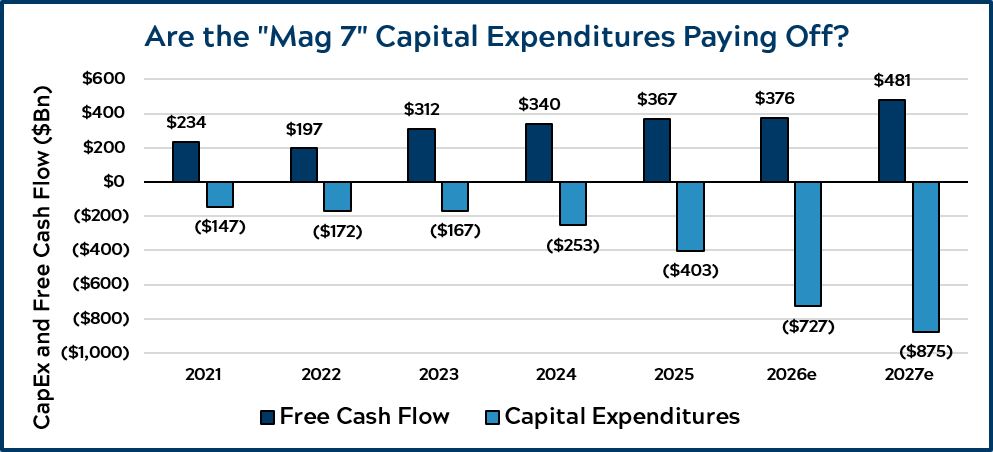
A similar dynamic is beginning to emerge today. The chart below shows a relative plateau in free cash flow growth for the Magnificent Seven (Apple, Microsoft, Amazon, Google, Meta, Tesla & Nvidia) compared to a sharp acceleration in capital expenditures.
Source: FactSet
During the early stages of the AI buildout, major technology companies primarily funded their investments through internally generated cash flow. Companies are increasingly supplementing those investments by issuing debt and equity as capital requirements continue to expand. Technology sector bond issuance has accelerated, and the largest AI infrastructure providers now represent a growing share of the investment-grade corporate bond market. This evolution does not imply that AI investment is misguided; rather, it reflects the enormous funding requirements necessary to build the digital infrastructure supporting what may become one of the largest productivity revolutions in modern history.
For investors, the more important question is no longer whether artificial intelligence will influence the economy. It is who ultimately captures the economic value.
Accordingly, we are increasingly focused on the businesses that use artificial intelligence to improve productivity, expand margins, strengthen competitive advantages, and generate higher long-term returns on capital. History suggests that while infrastructure builders create the foundation for innovation, the greatest beneficiaries are often the companies that successfully integrate new technologies into their business models.
Every generation experiences a technological frontier that reshapes the economy; artificial intelligence may prove to be this generation's digital frontier. Our objective as investors is not simply to identify the companies spending the most on it, or even to recognize that change is coming. It is to identify which companies will convert that investment into durable earnings growth and lasting shareholder value. We believe that process is only beginning, and it is likely to create investment opportunities well beyond today's market leaders.
A Different Kind of Feedback Loop
Does this time look different?
“This time is different” has preceded more disappointment than vindication in market history. Still, artificial intelligence carries one genuine structural distinction from the railroads, the electrical grid, and the internet before it.
Those prior transformations advanced through a human-mediated cycle: people observed results, ran the next experiment, built the next iteration. AI increasingly participates in its own improvement. Models now help generate their own training data, evaluate other models' outputs, and accelerate the research that produces the next generation of systems. The tool has become part of the process that improves the tool.
We take that seriously, but we are equally mindful of its limits. This feedback loop still runs through capital, power, and data constraints, and through human judgment, not around them. Evidence of diminishing returns to simple scaling is already emerging.
More importantly, a faster feedback loop does not automatically concentrate value with whoever moves fastest. Technologies that improve and diffuse quickly also tend to commoditize quickly; today's proprietary edge often becomes broadly available capability within a year or two. We are already seeing this as smaller, more efficient models rival far larger predecessors. If that pattern holds, AI's self-improving nature may erode competitive moats faster than it entrenches them further shifting value away from frontier model builders and toward the businesses that put increasingly commoditized intelligence to disciplined, profitable use.
Which brings us back to where this letter began: not the pace of innovation, but the durability of the returns it produces.
Investing in the Final Frontier
Where will tomorrow's opportunities come from?
The story of America has always been one of new frontiers: political, geographic, technological, and financial.
As America recently celebrated its 250th birthday, investors also witnessed another milestone in American innovation: SpaceX's public-market debut this past month, pushing us deeper into the final frontier.
The timing is notable. The nation's founding itself was an act of extraordinary financial risk-taking and optimism, built on the belief that free people pursuing opportunity could create something lasting and new.
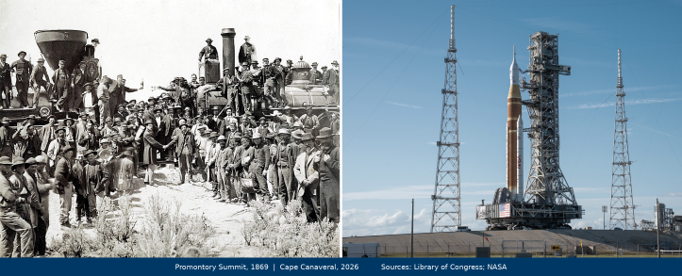
That pattern continued through westward expansion, when capital flowed into canals, railroads, telegraphs, ports, mines, and cities long before returns were certain. The process was uneven, and not every investor benefited. But over time, those investments connected a continent and helped lay the foundation for the world's largest economy.
We made this point about artificial intelligence earlier in this letter, and it applies with equal force to commercial space: infrastructure and investment success are related, but they are not synonymous. Just as artificial intelligence represents today's digital frontier, commercial space may represent tomorrow's physical frontier. The same question follows it there. SpaceX's public debut does not settle whether space infrastructure investors will be rewarded; it confirms that the capital is now flowing at scale, which is exactly the stage at which the railroads and the telecommunications buildout stopped being sure things. Our challenge as investors is not simply to recognize that change is coming. It is to identify which companies will ultimately capture that value as the frontier unfolds.
Perhaps that is why the timing feels so appropriate. As America celebrates 250 years of innovation, entrepreneurship, and risk-taking, it is once again asking investors to finance a new frontier. The geography may be different, but the questions remain familiar.
Where will capital flow? Who will create lasting value? Which investments will still matter a decade from now? Those are the questions that continue to guide our thinking at Resonant Capital.
Every generation inherits uncertainty. Every generation also inherits opportunity. Our responsibility is not to predict every technological winner or every market cycle. It is to thoughtfully allocate capital toward businesses and ideas most likely to create enduring value over time.
The frontier has changed. The principles of investing have not.
The Resonant Principles
Successful investing is shaped as much by enduring principles as by current events. Markets, technologies, and economic conditions evolve continuously, but the disciplines that protect and grow wealth have remained remarkably consistent over time.
Beginning with this issue, in our quarterly letter we will feature one of our ten guiding investment principles. These principles are not forecasts or market opinions. Rather, they are the beliefs refined over a lifetime of investing that continue to influence how we evaluate opportunities, manage risk, and allocate capital on your behalf.
Our hope is that these principles provide you greater insight into what we are doing, and why we are doing it.
Resonant Principle: Price Matters
Great businesses do not always make great investments.
The return an investor earns is determined not only by the quality of the business, but by the price paid to own it. Valuation remains one of the few variables investors can control. Historically, valuation discipline has proven a reliable way to preserve and grow wealth over full market cycles.
Markets periodically become captivated by compelling narratives. We share the enthusiasm surrounding transformative technologies such as artificial intelligence and commercial space. Yet history reminds us that even extraordinary businesses can produce disappointing investment returns when purchased at extraordinary valuations.
Price does not determine whether a business will succeed, or whether a stock will perform in the short-term. It does, however, play a significant role in determining the return an investor ultimately receives in the long run. For that reason, valuation discipline remains an essential part of our investment process.
Resonant Capital Advisors, LLC (“Resonant”) is an SEC registered investment adviser headquartered in Madison, Wisconsin. This communication is limited to the dissemination of general information and, accordingly, should not be construed, in any manner whatsoever, as a substitute for personalized individual advice from Resonant. Always consult an attorney, tax or financial professional regarding your specific legal, tax or financial situation.
This communication contains certain forward‐looking statements (which may be signaled by words such as “believe,” “expect” or “anticipate”) which indicate future possibilities. Due to known and unknown risks, other uncertainties and factors, actual results may differ materially from the expectations portrayed in such forward‐looking statements. As such, there is no guarantee that the views and opinions expressed in this communication will come to pass. Past performance is not indicative of future performance. Investing involves risk, including risk of loss.
This communication may also discuss and display charts, graphs and formulas which are not intended to be used by themselves to determine which securities to buy or sell, or when to buy or sell them. Such charts and graphs offer limited information and should not be used on their own to make investment decisions.
Although all information provided in this communication is gathered from sources deemed
to be reliable, we cannot guarantee the completeness or accuracy of such information. The information should not be regarded as a complete analysis of any subject discussed. All opinions included constitute the authors’ judgment as of the date of this communication and are subject to change without notice.
For additional information about Resonant, please request our disclosure brochure as set forth on Form ADV or refer to the Investment Adviser Public Disclosure web site (www.adviserinfo.sec.gov). Please read the disclosure statement carefully.