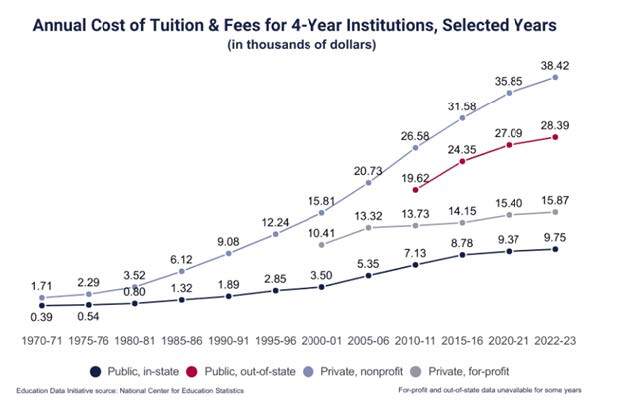
In the 1963–64 academic year, the average tuition and fees at a public four-year university were just $243*. That number has risen to $9,750, with costs increasing 141% in the past two decades alone. Factor in books, supplies, and room and board, and the total annual cost at an in-state public university climbs to around $39,000. Over four years, families can expect to spend roughly $108,000 or more per student.
*Source: Education Data Initiative, National Center for Education Statistics; For-profit and out-of-state data unavailable for some years. Data pulled as of June 2025
With education costs continuing to climb, proactive planning has never been more important. Whether helping children, grandchildren, or another family member, understanding your options and choosing the right strategy early on can reduce financial stress later—and ensure your broader financial goals stay on track.
Education Planning Vehicles
529 Plans
529 plans remain one of the most popular and effective tools for education funding. Contributions are made with after-tax dollars and grow tax-deferred over time. When used for qualified education expenses—including tuition, fees, books, supplies, and room and board—withdrawals are tax-free. Many states also offer income tax deductions or credits for contributions to their in-state 529 plans, adding an additional layer of benefit for families looking to maximize their education savings.
Qualified Expenses: Tuition, Fees, Books, Supplies, Equipment, Room and Board.
Non-Qualified Expenses: Transportation, Travel, Extracurricular Activities, Entertainment and Amusement.
Recent legislation has made 529 plans more flexible than ever:
K–12 Tuition: Up to $20,000 per year can be used tax-free for private or religious elementary and secondary school tuition.
Apprenticeship Programs: Funds can be used for expenses tied to registered apprenticeship programs.
Student Loan Repayment: A lifetime maximum of $10,000 can be withdrawn to repay qualified student loans for the beneficiary and each of their siblings.
Roth IRA Rollover: Up to $35,000 (lifetime limit) may be rolled over from a 529 plan to a Roth IRA for the same beneficiary, provided the following requirements are met:
The 529 account has been open for at least 15 years.
Contributions (and earnings on those contributions) made within the past 5 years are not eligible for rollover.
The beneficiary must have earned income, and annual Roth IRA contribution limits still apply.
Uniform Transfer to Minors Act (UTMA)
Custodial accounts, such as those established under the Uniform Transfers to Minors Act (UTMA), are designed to hold assets on behalf of a minor. The custodian, typically a parent or guardian, oversees the account, including managing and investing the funds, and may use them for expenses that benefit the minor. Ownership of the assets remains with the custodian until the minor reaches the age of majority, which varies by state (commonly age 18 or 21). At that point, full control of the account and its assets are legally transferred to the child.
However, unlike 529s and Roth IRAs, UTMA accounts do not offer tax-deferred growth or tax-free withdrawals. Additionally, assets in UTMA accounts are considered the child’s on financial aid applications, which can reduce aid eligibility.
Roth IRA
Although Roth IRAs are traditionally used as retirement savings vehicles, both parents and children can leverage their tax-free growth to help pay for qualified education expenses. Withdrawals of earnings made before age 59½ can avoid the usual 10% early withdrawal penalty, provided the account has been open for at least five years. There is no strict limit on the withdrawal amount, as long as it does not exceed the total qualified education expenses incurred for the year.
However, it's important to weigh the potential impact on financial aid. While Roth IRA assets themselves are not considered when determining aid eligibility, any distributions are counted as income on the FAFSA. This can negatively affect financial aid awards in subsequent years.
Free Application for Federal Student Aid (FAFSA)
The Free Application for Federal Student Aid (FAFSA) determines eligibility for federal aid programs and is often required for merit-based scholarships and institutional aid—even for families who do not expect to qualify for need-based assistance.
Filing the FAFSA keeps more financial options available, regardless of income level. While high-net-worth families may not be eligible for certain aid programs, completing the form ensures access to unsubsidized federal loans, work-study opportunities, and school-based scholarships that may otherwise be missed.
Conclusion
With the rising cost of education and the wide range of financial aid options available, it’s important for families to choose an education planning strategy that aligns with their needs and long-term goals. Tax-advantaged accounts like 529 plans and Roth IRAs offer the benefit of tax-free growth and withdrawals for qualified education expenses, while UTMA accounts allow families to set aside assets that transfer to the child at the age of majority. By exploring all available options, families can effectively prepare for future education costs and support their child’s journey toward financial independence. If you have questions about how education planning fits into your overall financial strategy, please reach out to your advisor.
Resonant Capital Advisors, LLC (“Resonant”) is an SEC registered investment adviser headquartered in Madison, Wisconsin. This communication is limited to the dissemination of general information for educational purposes only and, accordingly, should not be construed, in any manner whatsoever, as a substitute for personalized individual investment advice from Resonant. The information presented does not intend to make an offer or solicitation for the sale or purchase of any specific securities, investments or investment strategies.
Resonant has reasonable belief that this communication does not include any false or material misleading statements, omissions of fact or will otherwise result in any untrue or misleading implications regarding Resonant’s services, investments or client experiences. Although all information provided in this communication is gathered from sources deemed to be reliable, Resonant cannot guarantee the completeness or accuracy of such information and the information should not be regarded as a complete analysis of any subject discussed. This communication is based on information available as of the date of this communication. There is no guarantee that the information will remain current or complete in the future.
Investing involves risk, including the risk of loss, and past performance does not guarantee future performance. Resonant and its employees are not legal or tax advice experts. The information presented in this communication does not constitute legal, tax or investment advice. Always consult an attorney, tax or financial professional regarding your specific legal, tax or financial situation.
For additional information about Resonant, please request our disclosure brochure as set forth on Form ADV or refer to the Investment Adviser Public Disclosure web site (www.adviserinfo.sec.gov). Please read the disclosure statement carefully.
Resonant Capital Advisors, 33 East Main St, Suite 440 Madison WI 53703 (608) 733-6220