The Long View
Good Processes Compound
“Compound interest is the eighth wonder of the world. He who understands it, earns it; he who doesn’t, pays it.”
-Often attributed to Albert Einstein
Resonant’s Founding CEO Walter Dewey often extended this familiar idea beyond finance, referring to the “compound interest table of life.” He believed that the quality of our lives is shaped less by any single decision than by when we begin making productive choices and how we add to them over time. Health, relationships, knowledge and character are built through small decisions that accumulate. A single workout changes little; years of consistent exercise can change a life. The books we read, the people we surround ourselves with, and the habits we cultivate all shape our future in ways that may not be apparent day by day. Investing follows the same principle. Sound processes improve the quality of our decisions, and good decisions compound over time, even though outcomes will still vary. The task is to evaluate the evidence, understand the risks we take, and make decisions that can stand up across a range of market environments. That discipline matters in today’s market. Strong corporate earnings have supported stock prices despite rising interest rates and mounting economic and geopolitical risks. The central question is whether earnings can continue to grow fast enough to justify a higher cost of capital.
3rd Quarter Market Review
The third quarter saw economic strength despite tighter financial conditions. The economy remained resilient, corporate earnings were exceptionally strong, and business investment accelerated, led in large part by investors’ belief in the potential of artificial intelligence. Yet inflation remained above the Federal Reserve’s target, oil prices rose to over $100 a barrel, the Fed raised interest rates for the first time since 2023, and the 10- year Treasury yield climbed to its highest level since 2007.
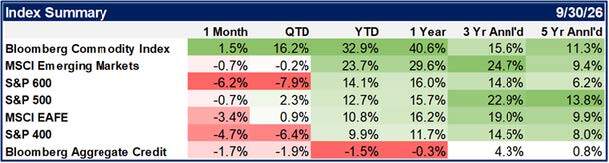
Large-cap stocks advanced against this backdrop, while mid- and small-cap stocks declined. The S&P 500 set several new highs and rose 2.3% for the quarter, bringing its year-to-date return to 12.7%. Smaller companies, which had led the market earlier in the year, reversed course as higher bond yields weighed on sentiment. The S&P MidCap 400 Index returned -6.4% and the S&P SmallCap 600 Index fell -7.9% for the quarter, still leaving their year-to-date returns at 9.9% and 14.1%, respectively.
International markets were mixed. The MSCI EAFE Index gained 0.9%, lifting its year-to-date return to 10.8%, slightly behind the S&P 500. The MSCI Emerging Markets Index declined -0.2% for the quarter but is still up a strong 23.7% for the year. Leadership within emerging markets has been notably narrow. Taiwan and South Korea, which together account for roughly 40% of the benchmark, have benefitted from heavy exposure to semiconductor manufacturers and other companies tied to the AI supply chain.
Returns for fixed income investors were broadly lower as inflation concerns and a more hawkish Federal Reserve pushed rates higher across the yield curve. Policymakers raised the federal funds rate by 0.25% in September, to a target range of 3.75% - 4.00%. As investors embraced a “higher-for-longer” outlook, the 10-year Treasury yield surpassed 5% for the first time since 2007. The 30-year yield moved above 5.4%, and average 30-year mortgage rates approached 7.5% by quarter end. Because rising yields mean falling bond prices, the Bloomberg Intermediate Government/Credit Index declined -1.9% for the quarter and is now down -1.5% for the year.
Commodities far outpaced both stocks and bonds. The Bloomberg Commodity Index, led by a sharp rise in oil prices, returned 16.2% for the quarter and 32.9% year-to-date. Higher energy costs, in turn, added to inflation pressures and reinforced the Fed’s hawkish stance.
Earnings Overwhelmed Concerns, For Now
The third quarter gave investors plenty to worry about. Rising Treasury yields threatened equity valuations, persistent inflation raised the prospect of prolonged tighter monetary policy, conflict in the Middle East pushed energy prices higher, and questions persisted about whether the hundreds of billions of dollars spent on AI would generate satisfactory returns to justify elevated stock prices.
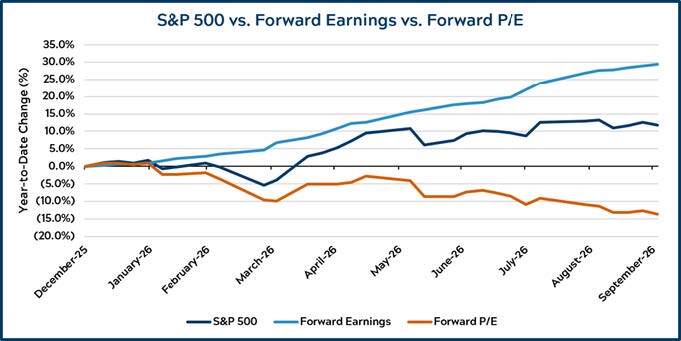
The S&P 500 climbed the wall of worry during the quarter as investors looked past concerns and focused on the remarkably strong earnings being generated. Second quarter S&P 500 earnings grew roughly 50% from a year earlier, the strongest increase since 2021. Excluding unusually large investment gains by Alphabet and Amazon, the index’s earnings grew 31%. Profit growth of that magnitude became the antidote to concerns for the time being. For every worry the market faced, the answer was the same. Rising Treasury yields? Earnings are strong. Higher oil prices? Earnings are strong. A more hawkish Federal Reserve? Earnings are strong. Interestingly, the S&P 500’s gains have not come from investors paying ever higher prices for stocks. Below, we show that forward valuations for the index have held steady or even declined as earnings grew faster than share prices.
The market’s resilience does not mean the risks have disappeared. It reflects a judgment by the market that earnings growth currently outweighs them. That support can persist, but it depends on profits continuing to justify a rising cost of capital, a question we discuss below.
The AI Investment Boom Behind the Earnings.
As we discussed last quarter, artificial intelligence capital expenditures are changing the economic landscape. AI is no longer a technology story; it has become an economic investment cycle. The largest technology companies are committing enormous sums to data centers, semiconductors, networking equipment and power infrastructure. That spending flows directly into revenues and earnings of the companies building and supplying the buildout, and into broader economic growth. Companies tied directly to AI infrastructure could account for roughly half of S&P 500 earnings growth over the next two years, helping explain why large cap stocks held up while other parts of the market struggled.
This marks a shift. For much of the period following the Global Financial Crisis, growth depended heavily on consumer spending. Today, capital investment is becoming a more important source of demand, with AI at its center. Much of this investment is being driven by a handful of enormously profitable companies committing hundreds of billions of dollars based on their expectations of future demand. Consumers remain the primary driver of economic growth. The scale of current capital expenditures, however, suggests their share of total economic spending may be gradually declining as business investment becomes a larger contributor to overall economic activity. Consumer spending has historically averaged about 70% of total economic output. At least one strategist we follow expects this figure to decline toward 50%. While that will be an important trend to monitor, it is difficult to imagine a hawkish Federal Reserve materially slowing the current investment cycle. For the time being, many of the companies driving this spending are exceptionally profitable, and their investment decisions appear to be driven more by long-term growth aspirations than changes in financing costs.
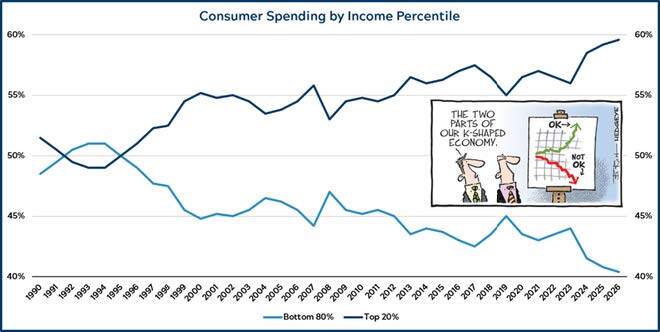
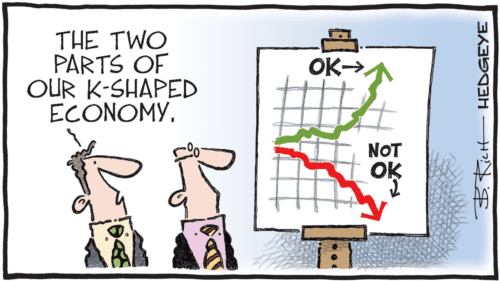
In the meantime, rising stock prices have lifted household wealth, particularly among higher income households, helping sustain spending even as borrowing costs climb. The accompanying chart compares how spending by income percentile has been trending upward for those in the top 20%. Higher rates have already contributed to weaker market breadth, with gains increasingly concentrated among a smaller group of large-cap companies. If rates continue to rise or simply remain elevated for an extended period, the pressure could eventually extend to large-cap stocks as well, weakening an important source of support for consumer spending and economic growth.
The Competition for Capital
For more than a decade, cash offered little compensation relative to risk assets, and the acronym TINA (“There is No Alternative”) captured the mood. TINA has now retired.
For much of the period following the Global Financial Crisis, the world operated under an unusual financial regime. Central banks kept interest rates low, governments borrowed freely, corporations refinanced cheaply, and investors learned to value assets against an exceptionally low cost of capital. Housing, equities, private equity and commercial real estate were shaped by this environment.
Today, the United States is running large fiscal deficits, foreign demand for Treasuries appears less reliable, and deglobalization seems to be gaining momentum. Meanwhile, corporations, especially those funding the AI buildout, are issuing more investment grade debt. Investors must absorb more bonds, more duration risk and more uncertainty.
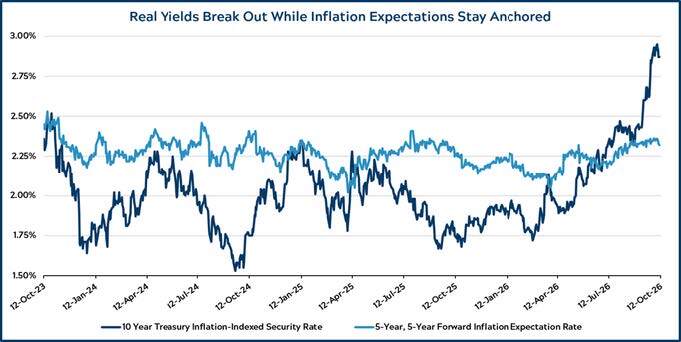
The composition of the rise in yields is important. Real yields have moved meaningfully higher while market-based inflation expectations have remained relatively stable. The accompanying chart compares the 10-year TIPS yield with the 5-year, 5-year forward inflation expectations yield. This suggests that the rise in nominal yields reflects more than inflation concerns. Investors are demanding greater compensation for holding longer-term bonds amid geopolitical conflict, persistent inflation, higher oil prices and a more hawkish Federal Reserve. The term premium, which represents the additional compensation for holding longer-term bonds, has also risen after spending much of the past decade near or below zero.
Note: 10-Year Treasury Inflation-Indexed Security Rate = Inflation-Adjusted Yield; 5-Year Inflation Expectations is a Market-Derived Metric
At close to 3.0%, the 10-year real Treasury yield has returned to levels last seen during the Global Financial Crisis era. The implication for investors is that when government bonds offer nearly 3% above inflation, risk assets must offer sufficient expected return to justify their additional uncertainty. Higher real yields raise the discount rate applied to future earnings and increase the return hurdle for equities, putting pressure on valuations and leaving less room for disappointment.
There is an irony here worth noting. AI spending is driving much of today’s economic and profit growth, but the debt financing behind it is also adding to the supply of bonds pushing yields higher. The same force supporting earnings is helping raise the bar those earnings have to clear.
Investors once again have access to reasonable returns without being forced to assume ever-greater levels of risk. As a result, every asset must now compete for their capital.
The New Math of Higher Rates
While attention often centers on their impact on bonds, the effects of higher yields are far more widespread. They influence valuations, borrowing costs, and expected returns across virtually every asset class.
Bond investors have felt the impact most directly. Existing bondholders absorbed losses this quarter, but higher yields have improved prospective returns and restored income as a meaningful part of fixed income investing. As we like to say in the office, “your starting yield is your destiny,” meaning a bond’s starting yield remains one of the strongest indicators of its long term performance. The rise in rates has created a meaningful reset in yields, improving the outlook for future fixed income returns.
Real estate and private markets may face a different adjustment. Assets acquired or developed when financing was inexpensive will eventually need to be refinanced at higher rates. More expensive borrowing, lower leverage and higher return requirements are likely to weigh on future returns. Private assets may be repriced more slowly than public markets, but their underlying economics must still adjust.
Rising yields have often made conditions more difficult for equity investors. Higher real yields increase the return available from relatively safe assets and raise the discount applied to future corporate earnings. Companies whose valuations depend on distant profits are especially exposed. By contrast, strong current cash flow, durable margins and limited financing needs become more valuable. Warren Buffett often emphasized the importance of maintaining ample reserves, observing, in paraphrase that “we never want to depend on the kindness of strangers to meet tomorrow’s obligations.” Strong earnings growth can offset much of the pressure from higher real yields, as the third quarter demonstrated. But the margin for error is shrinking. If earnings disappoint while real yields remain elevated, investors could face pressure from both sides: slower profit growth and lower valuation multiples.
The Price of Capital
The third quarter reinforced the central investment principle that the cost of capital matters. For much of the past decade, investors have operated in a world of abundant, inexpensive capital. As capital becomes more expensive, financing grows more selective and the differences between strong and weak business models become more consequential. In this environment, valuation remains a key consideration of our investment process. We do not know where interest rates will ultimately settle. What we do know is that higher financing costs change investment economics, raise return requirements and increase the importance of balancing growth expectations with the price paid.
Through every market cycle, our focus remains the same: analyze the forces shaping the investment landscape, distinguishing evidence from narrative and maintain a disciplined investment process that supports decisions capable of holding across a range of outcomes.
As we noted at the start, good decisions have a way of compounding into solid results over time. The last four years have seen investors amply rewarded for taking equity market risk. The bond market is now suggesting that future stock returns will face stiffer competition from other asset classes. We are focused on positioning portfolios for this transition without sacrificing long-term return.
Looking Ahead
The forces tightening the margin for error include higher real rates, oil near $100 a barrel, persistent inflation, a more hawkish Federal Reserve and narrow market leadership. Each affects the outlook, and together they make valuation discipline and
earnings especially important.
The wealth effect created by rising stock prices, combined with substantial capital spending by the largest technology companies, has helped offset a growing list of concerns. Rising markets support consumer spending, and strong consumer spending supports corporate earnings. Of course, the relationship can work in reverse.
We are monitoring the impact of higher interest rates on stock market activity, particularly whether higher rates begin to weigh on valuations and investor risk appetite. We are also watching AI-related capital spending closely, along with signs of strain emerging in the credit markets.
We are responding with portfolio discipline. Following several years of strong stock market appreciation, we are generally rebalancing portfolios to target allocations. Higher financing costs can be particularly challenging for smaller companies, so we are reassessing small- and mid-cap exposure where the risk-reward trade-off has deteriorated. We also replaced a portion of our intermediate term government debt with Treasury Inflation Protected Securities (TIPS) in our model portfolios. These actions are designed to keep portfolios aligned with their long-term objectives while focusing on opportunities that offer attractive risk adjusted returns.
Investment Principle
Directionally Right, Not Perfect
“Le mieux est l’ennemi du bien.”
(“The best is the enemy of the good.”)
-Attributed to Voltaire
Investing requires decisions to be made in an uncertain world. We rarely have all the information we would like, and the evidence seldom points in one direction with complete certainty. Waiting for perfect clarity can be as costly as acting too quickly.
Our objective is not to make perfect decisions. It is to build a disciplined process that helps us make good decisions consistently. We gather evidence, evaluate competing explanations, weigh potential returns against the risks, and act when the balance of evidence supports a decision. That does not require every indicator to agree or the outcome to be certain. It requires enough conviction to act, paired with the humility to recognize what we may be missing. It also requires valuation discipline.
A sound process does not eliminate mistakes. It helps us distinguish a good decision that happened to have produced an unfavorable outcome from a poor decision that happened to work. Both successes and failures offer opportunities to learn, refine our thinking and improve our process over time.
This requires a willingness to change our minds when evidence changes. Discipline does not mean rigidly adhering to an original view, it means remaining faithful to a process while allowing new information to inform our decisions.
We cannot control markets or predict every outcome, but we can be diligent in our research, deliberate in our decisions, honest in our assessments, and willing to learn from experience. Over time, that combination offers a more reliable path to investment success than the pursuit of perfection.