The markets pulled back in the 3rd quarter as interest rates increased and, despite having provided the market with much of the gains year-to-date, the largest technology company stocks lost some of their momentum. The S&P 500 declined -3.3% for the quarter but is up 13.1% for the year.
Attention has turned to the bond markets following the tightening of financial conditions after a historic period of artificially low interest rate policy of the Fed and other central banks. We look at the bond market in an environment where the Fed’s overnight lending rate has gone from essentially zero to a range of 5.25-5.50%.
Growth in the labor market has continued to keep the unemployment rate very low, corporate profits remain strong as companies pass along price increases to consumers who remain resilient despite slower price increases from higher levels. The outbreak of war in the Middle East adds additional risk to the current market environment.
We close with a description of recent moves in the positioning of our portfolios, which are designed to reduce risk within our bond portfolios and generally reduce equity exposure. We remain cautious in an increasingly uncertain environment.
Third Quarter Recap
The financial markets went into retreat during the third quarter of 2023 as interest rates rose and the momentum of the “Magnificent Seven” large technology companies began to wane. The benchmark S&P 500 declined by -3.3%, which shrunk its nine-month return to 13.1%. Mid and Small capitalization companies fell by -4.2% and -4.9%, respectively, taking their 2023 returns to 4.3% and .8%, respectively. It is no small irony that the S&P 500’s performance exclusive of the contribution from the seven technology giants has a return very close to the mid and small stock indices. Strength in the U.S. dollar dampened the returns of international companies and the developed market MSCI EAFE index fell by -4.1% in the quarter to take its nine-month return to 7.6%. The MSCI Emerging market index was down -2.8% for the quarter, but up 2.2% so far this year.
Bonds were terrible during the quarter as the benchmark 10-year maturity Treasury bond yield rose from 3.81% on June 30th to 4.57% on September 30th, a full .76% in one quarter. This rise in marketable rates took the Bloomberg Intermediate Government/Credit Index down -.83% for the quarter, bringing its year-to-date return to .65%. Tax-exempt bonds fared worse as the Bloomberg Municipal 1-10 year Index fell -2.23%, bringing the nine-month return to -.81%. In hindsight, a material uptick in interest rates only resulting in low single digit index losses can be viewed as a positive outcome. The resilience of corporate earnings and the continued low unemployment rate were clearly factors in keeping the financial markets from experiencing a more pronounced decline.
Stock Investors are Crowding into the Sainted (Magnificent) Seven
We have noted before that human brain function is akin to a powerful recognition and sorting machine. “Where have we seen this before and how should I respond to it” is a conscious or unconscious event that occurs multiple times during the course of our day. Stock investors have a more difficult time with this function because the circumstances are always changing relative to where activity and earnings growth are happening in the economy. But once those observations on where the growth is located are well-established, investors typically crowd into those areas (companies) aggressively. Nobody wants to miss out on Artificial Intelligence (AI) and the above data makes clear that there has been little return opportunity elsewhere.
Apple, Microsoft, Alphabet (Google), Meta Platforms (Facebook), Tesla, Nvidia, and Amazon are the members of this exclusive club, and most of them have market values exceeding $1 trillion. Apple has a market value of $2.7 trillion and Microsoft is $2.35 trillion. By comparison, Wal-Mart and ExxonMobil command relatively “small” $430 billion market capitalizations. In an index like the S&P 500, size really does matter because the bigger the market value an individual company has, the larger the impact that company will have on the index return. For example, the impact from the 86% return for Royal Caribbean Cruise Lines (RCL) this year is dwarfed by the 32% return from Apple. The simple reason is that RCL is worth $23 billion in the stock market and Apple is worth the $2.7 trillion mentioned above. When the biggest companies perform far better than virtually all others, the S&P 500 and the NASDAQ become the performance leaders by a wide margin. And that is the story of 2023.
This crowding into just a few companies also happened during a period in the late 1960s and early 1970s, when a slightly larger group of companies were dubbed the “Nifty 50.” Those companies were the highest quality companies of the day and investors assumed they could be bought at any price, regardless of their valuations. The stock market collapse in 1973-1974 was particularly hard on these firms as their inflated valuations came crashing down to earth. Many firms that were viewed as having little business risk are now largely or entirely out of business (has anyone taken film in for development lately, Eastman Kodak?).
Our reason for elaborating on the capitalization weighted index and the similarities to comparable history is that this is a very rare circumstance. The biggest companies having truly exceptional price momentum will normally be accompanied by a rare story like AI. But investor enthusiasm will also catalyze a reaction from those buying the products that are causing the enthusiasm. For example, the big AI companies using Nvidia chips are now trying to design their own chips to get around Nvidia’s market dominance. There have also been numerous reports of the big AI companies struggling to find a profitable economic model given the very large upfront and ongoing expense of operating these technologies. In short, the stock market sees this as the next big thing while we view it as another technology that will take time to develop. And that means the high momentum trade around AI in the “Sainted Seven” companies could soon face challenges.
The Bond Market is Back in Charge
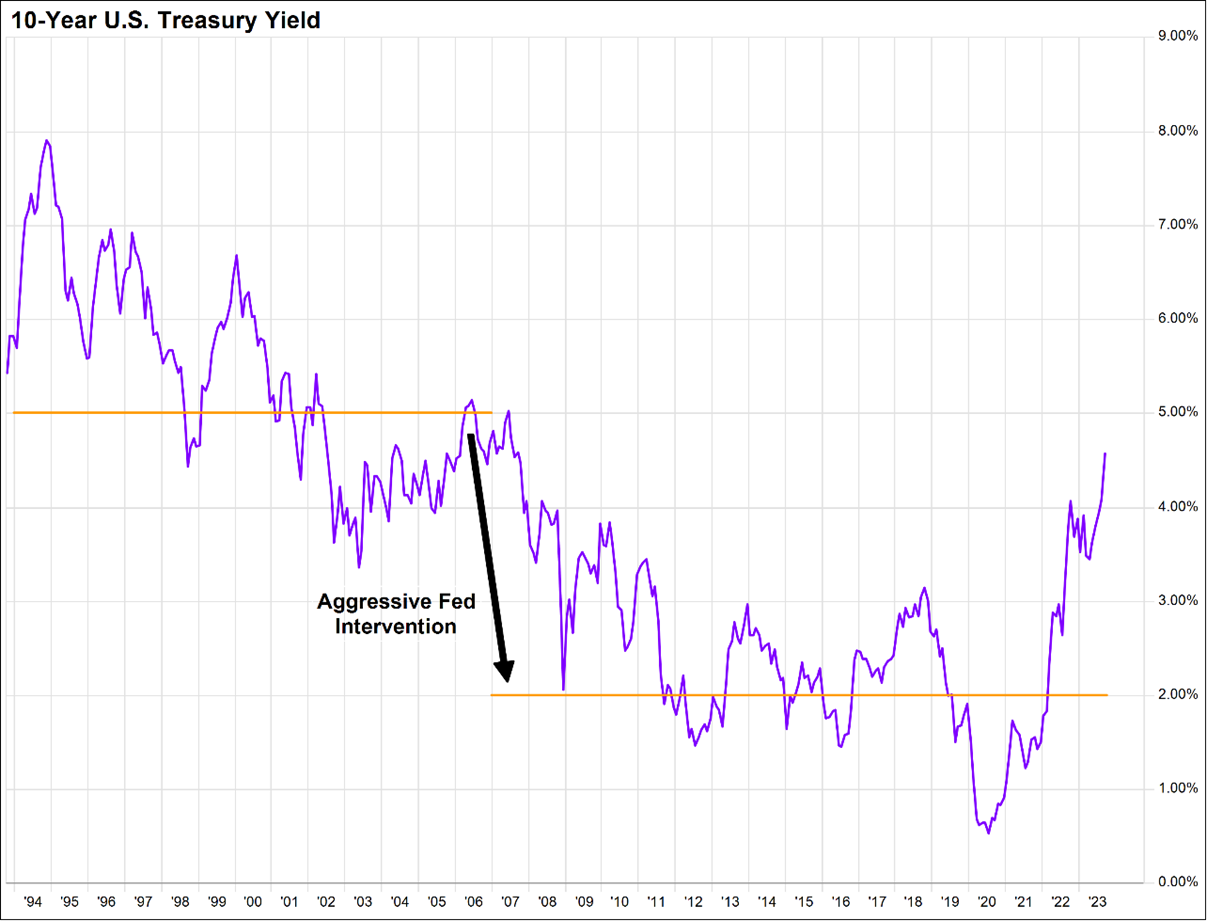
Bill Clinton advisor James Carville once remarked that if he could be reincarnated, he wanted to come back as the bond market because “You can intimidate everybody.” Sadly, that was uttered nearly thirty years ago, and few remember what such intimidation looks like. For several years we have written about the misguided policy of the Federal Reserve and other central banks to pursue an artificially low interest rate policy. The first rule of economics is that if a price goes down, the demand for that good or service is more likely to increase. And we have seen this have a significant impact on consumer purchases like housing and in the debt issuance of the Federal Government as feckless politicians spent recklessly because the cost of doing so was so low. That era has ended. The Fed’s targeted overnight lending rate has been increased from essentially zero to the current range of 5.25%-5.50%. This has prompted widespread credit contraction and the aforementioned bond market intimidation beginning in earnest as the “regulated” interest rate’s rise has now been joined by the “market” interest rate on the benchmark ten-year maturity Treasury. As referenced above, the latter rate has climbed to 4.57% as investors demand a yield closer to what they can earn on a money market investment.
Bond investors can also no longer count on the Fed to buy bonds alongside them as the central bank did during and after the Covid pandemic. Quantitative Easing (QE) was the Fed’s direct investment in Treasury securities, essentially printing money in order to buy those bonds. For perspective on how massive this effort was, we can compare the Fed’s asset base on February 27, 2020, of $4.158 trillion to its assets on March 23, 2022, of $8.962 trillion – an increase of $4.8 trillion. These were bonds the Fed bought that the public did not have to. And as the Fed did not care about earning a high interest rate, they were artificially keeping rates lower than they theoretically should have been. Of course, all this extra money in the financial system had to go somewhere and our persistently stubborn inflation rate is clearly one of the results of this policy. The significant move up in the public and private equity markets and real estate were obvious outcomes as well. But just as the Fed gave, they are now taking away. Their balance sheet on September 28 was down to $7.956 trillion – a reduction of $1 trillion from March, 2022. When the Fed chose not to buy new bonds, they allowed a market interest rate to prevail. And that market rate is much higher than it had been as investors demanded a fair return for the inflation risk they were subject to.
Another factor driving rates higher is the fiscal mismanagement of the U.S. government. We warned of this oncoming risk earlier this year and suggested that financial markets would soon pay closer attention to the problem. Interest costs are now the fastest-rising expenditure category for the federal government, and there are no signs of it slowing down. Historically, a booming economy with low unemployment and high corporate profits would result in federal deficits shrinking to a low point in a positive economic cycle. Today, federal spending is near 25% of gross domestic product, a level of spending well above the pre-Covid number of 20%. Any modicum of discipline in federal spending to simply keep the ratio of expenditures at the same share of GDP as 2019 would greatly reduce the vulnerability to debt the U.S. now finds itself in. We have no confidence that our elected representatives will act before there is a crisis, and a crisis is clearly brewing. The banking sector had trouble in the early part of this year as interest rates rose and their “safe” treasury securities declined in value. Those same bankers are now becoming more cautious about who they lend to and what they lend against. This credit contraction is reducing the available capital throughout the economy as the return of one’s money becomes more important than the return on their money.
We are not of the opinion that the Fed is looking for an excuse to ease credit conditions and put us back on the path of inflating asset values. Instead of the free money, low interest rate environment of the 2007 to 2022 period, a more likely outcome is that interest rates will be more historically “normal”, i.e. they will be in the range they were the fifteen years before the financial crisis. The below graphic depicts the pre-crisis average of the ten-year Treasury yield and the post-crisis average. The basic explanation for this is that investors want more return for the inflation risk they are taking. Our belief is that the ten-year Treasury will average closer to 5% over the next decade after averaging much around 2% over the last decade. Investors are coming to this conclusion very slowly, and our fear is that an extended period of complacency could give way to a more abrupt realization, with difficult consequences.
Source: Factset
"The World Needs Ditch Diggers Too"
This memorable quote from Judge Smails to Danny Noonan in “Caddyshack” (Danny was lobbying for a scholarship from the Judge - see picture below of the legendary characters) ran through our minds when we reviewed the most recent employment data. It turns out that if you pay people not to work and tell them they don’t have to honor their debts, most of them won’t do either.
The recent surge in hospitality employment suggests that student loan repayments restarting had an impact on the desire of individuals to work and commence previously-forestalled repayments. There is also abundant data that those who were deferring their student loan repayments did
not set cash aside for the prospective return of debt service. Instead, they used credit to buy consumer goods, houses and services during the pandemic and both (consumer and student) debts must now be serviced. By using credit during the pandemic at very low interest rates and on the misplaced assumption that student loan obligations had disappeared forever, a great deal of consumption was pulled forward. The good news is that low interest rates are locked into mortgages on properties where the payments are much more reasonable than they had been during the financial crisis. The bad news is that the level of debt is very high on an absolute basis, and that means it will take significant time for borrowers to pay down those loans.
Inflation has retreated from the 8% levels that garnered attention last year and now sits just over 3%. Unemployment is very low, sitting at under 3.4%. Corporate profits have remained strong as companies are routinely passing through price increases driven by higher labor costs. But consumers are feeling this pain, because prices are not coming back down. Instead, they are rising more slowly from a greatly elevated plateau. McDonald’s won’t bring back their dollar menu, but they will raise prices incrementally at a slower rate than before. The Federal Reserve knows this and will keep interest rates high until the unemployment rate moves up. Historically, the unemployment rate must rise by an absolute 2% before inflationary pressures subside. We do not believe that a 5.3% unemployment rate would be viewed as a “soft landing,” but that is what is likely to happen given historical precedent. Because interest rates, labor costs, and energy prices all impact the economy with a lag, we believe that economic growth and pressure on corporate profits will soon start to signal economic weakness. Especially with the uncertainty of war in the Middle East, a slowdown seems inevitable to us.
What We Are Doing
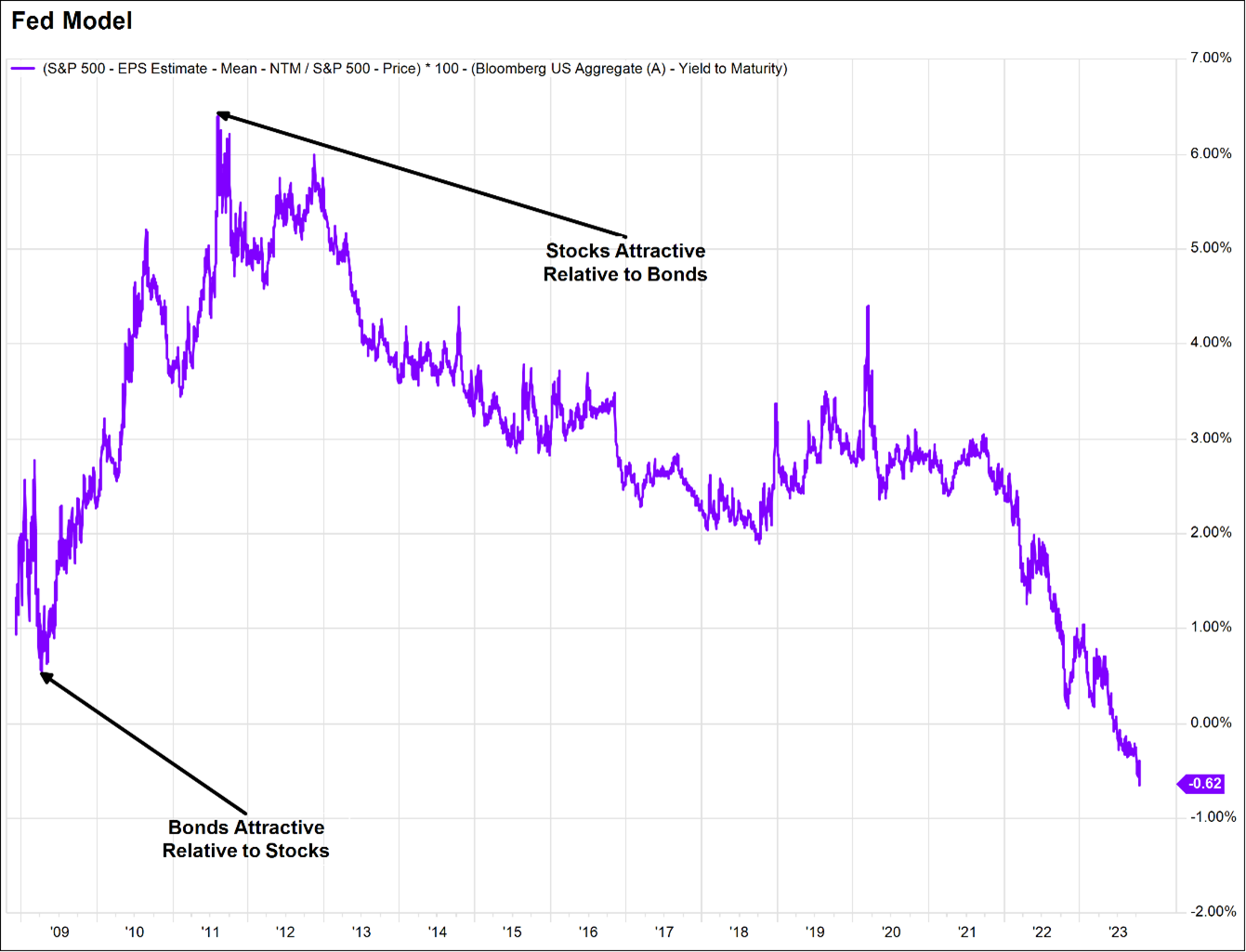
For those of you who have been reading our missives for a long time, there is a chart that we are very fond of referencing that has ties back to former Fed Chair Alan Greenspan. The “Fed Model” was an attempt to show the overvaluation of the stock market that Greenspan dubbed “Irrational Exuberance.” During this period, stock prices were very high compared to the interest rate on 10-year Treasury bonds. We always tweaked the model slightly to use A-rated corporate debt as a proxy for actual investor risk tolerance to get closer to a more realistic discount rate. That model is shown below. We have taken the expected earnings on the S&P 500 for the next twelve months and divided it by that A-rated interest rate. We have not brought this model up for many years because bonds were simply not a good place to invest due to the artificially low interest rate that they were carrying. With the recent sprint of rates to more normalized levels, our arrows point to stocks or bonds being relatively attractive compared to the other. And right now, bonds are becoming increasingly attractive compared to stocks. This tool is a good one for longer term asset allocation, but it is not useful for very short term or timing-related decisions. Asset prices can stay expensive or cheap for very long periods, and that means that we tend to move into or out of assets deliberately.
Source: Factset
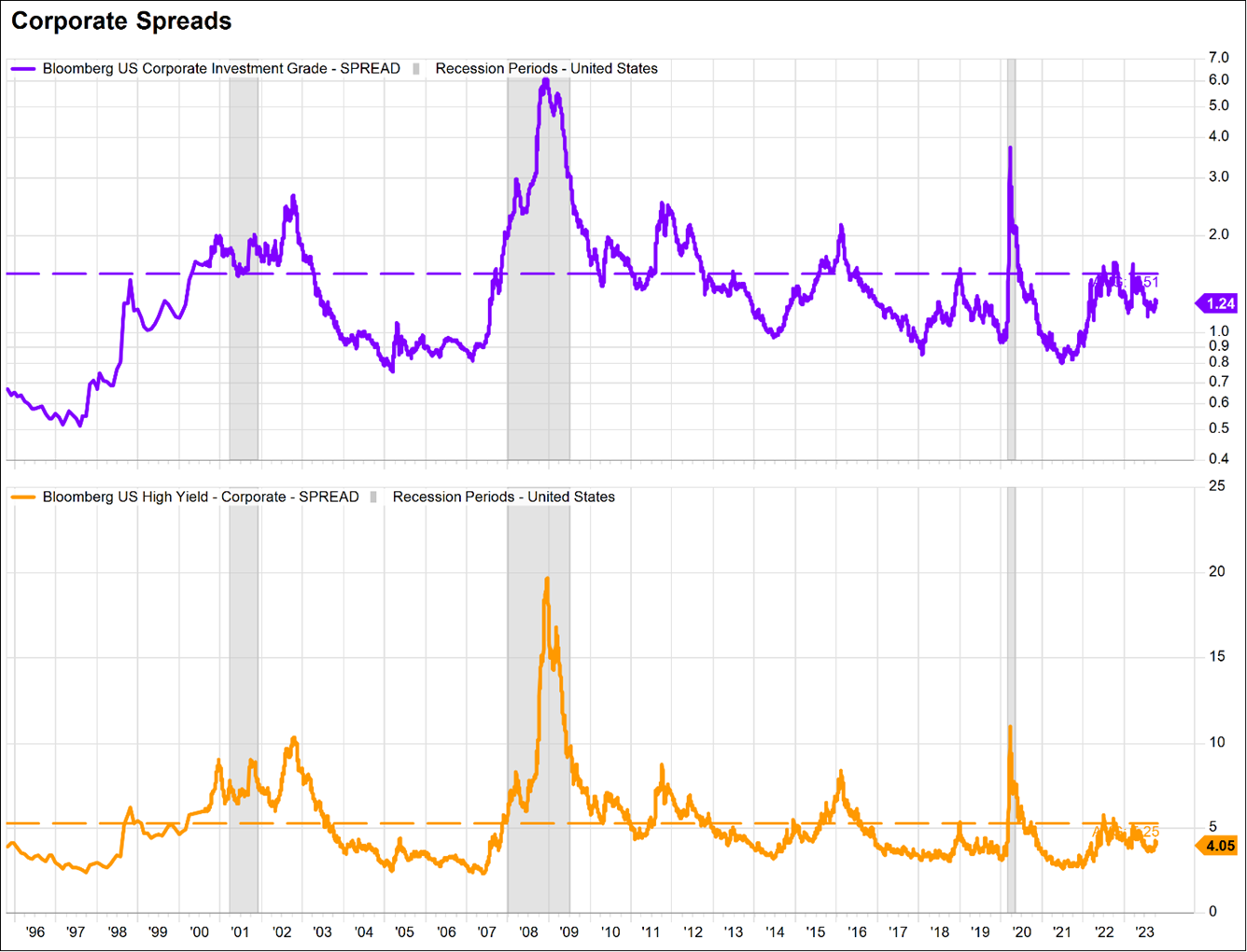
All the above commentary suggests we are cautious about the financial markets, and the move up in bond interest rates has us repositioning our portfolios. Last quarter we reduced our corporate exposure and increased our commitment to Treasury bonds. We also increased our exposure to inflation-protected securities. We refer to ourselves as “chicken bond investors” because we have an aversion to losing money in what is supposed to be a safe asset class. The moves we have made are designed to reduce the risk of the spread between corporate debt and Treasury debt from widening, and our portfolios suffering losses as a result. We have included an illustration below, which shows current spreads well below historical averages, especially compared to the highlighted recessionary periods. “Something is going to break” seems a likely outcome, as liquidity continues to drain from the system. These moves are designed to reduce risk within the bond portfolio as we also generally reduce equity exposure.
Source: Factset
Stocks are confounding currently, as the “Sainted Seven” have taken the S&P 500 higher even though virtually all indices representing stocks smaller than the giants have produced miniscule returns. The valuation of small and mid-sized companies is reasonable for the interest rate environment we forecast, so we are hesitant to reduce our equity commitment further. We are concerned about a rising unemployment rate, falling earnings, and debt service challenges on the part of companies and the government. The banking system gets plenty of attention because it is historically where credit circulates in the economy. But as banks have become more regulated, they have stepped back from this dominant role and now share the responsibility of lending with private funds that are designed to provide credit outside of the traditional banking system. Trouble may well start in some of these multi-billion-dollar hedge funds or private lending funds that have grown rapidly and largely outside of regulatory and public investor oversight.
Our cautious tone has been consistent for two years, and we do not see a compelling reason to change our outlook to one that is rosier (yet). Investors are going to be dealing with higher interest rates over the next decade, and that will keep valuations for stocks at lower levels than what they have become used to. Inflation is not gone, and the F ed’s efforts to get it back to a 2 percent level will take time and effort, with higher rates and rising unemployment as the result. The journey to this outcome is likely to make for more-challenging times in the financial markets.
Resonant Capital Advisors, LLC (“Resonant”) is an SEC registered investment adviser headquartered in Madison, Wisconsin. This communication is limited to the dissemination of general information and, accordingly, should not be construed, in any manner whatsoever, as a substitute for personalized individual advice from Resonant. Always consult an attorney, tax or financial professional regarding your specific legal, tax or financial situation.
This communication contains certain forward‐looking statements (which may be signaled by words such as “believe,” “expect” or “anticipate”) which indicate future possibilities. Due to known and unknown risks, other uncertainties and factors, actual results may differ materially from the expectations portrayed in such forward‐looking statements. As such, there is no guarantee that the views and opinions expressed in this communication will come to pass. Past performance is not indicative of future performance. Investing involves risk, including risk of loss.
This communication may also discuss and display charts, graphs and formulas which are not intended to be used by themselves to determine which securities to buy or sell, or when to buy or sell them. Such charts and graphs offer limited information and should not be used on their own to make investment decisions.
Although all information provided in this communication is gathered from sources deemed
to be reliable, we cannot guarantee the completeness or accuracy of such information. The information should not be regarded as a complete analysis of any subject discussed. All opinions included constitute the authors’ judgment as of the date of this communication and are subject to change without notice.
For additional information about Resonant, please request our disclosure brochure as set forth on Form ADV or refer to the Investment Adviser Public Disclosure web site (www.adviserinfo.sec.gov). Please read the disclosure statement carefully.