Equity markets continued their march higher in the 3rd quarter but saw a “broadening out” of performance that included small and mid-cap stocks, which had dramatically lagged large caps in the first half of the year.
The Federal Reserve enacted its first rate cut of the cycle, cutting its benchmark Fed Funds Rate by 50 basis points at its September meeting. We examine how much impact the Fed really has on broader interest rates and asset prices.
We remain cautious of elevated equity valuations as the year comes to a close and high-flying stocks grapple with the reality of necessary capital expenditures.
Third Quarter Recap
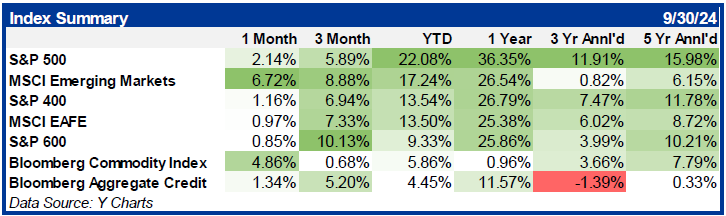
Stocks continued their unrelenting march higher during the third quarter as the S&P 500 Index returned 5.9%, bringing its nine-month total return to 22.1%. A broadening of participation saw medium and small sized companies also participate: the S&P MidCap 400 returned 6.9% and the S&P SmallCap 600 jumped by 10.1% during the quarter. This brought their respective year-to-date returns to 13.5% and 9.3%. Internationally, the developed markets MSCI Europe, Australasia, and Far East (EAFE) Index advanced 7.3% to bring the nine-month return to 13.0%. The MSCI Emerging Markets Index rose 8.9%, bringing the year-to-date return to 17.2%.
Interest rates declined as the benchmark 10-year maturity Treasury bond interest rate fell from 4.34% on June 30 to 3.79% on September 30. This meaningful decline drove the Bloomberg Intermediate Government/Credit Index to a 4.2% quarterly return, and a 4.7% return this year. Municipal bonds did not fare as well as the Bloomberg Municipal 1-10 year Blend was up 2.7% for the quarter and 1.9% for the nine months.
There is No Pattern to Recognize
In all of life’s endeavors, we make decisions that may or may not turn out to be good ones. And from them, we learn what we should do and what we should not do. We call that experience. Artificial Intelligence (AI) systems are built on powerful processors extracting patterns from large data sets to come up with a most likely answer. Those answers are based upon what has been observed in the past, and they are no different than our prognostications of what the financial markets may be doing over the short and long term. These quarterly missives are designed to keep readers appraised of our thinking on the financial markets, but we fully recognize how difficult it is to make accurate short-term prognostications. If you don’t have a lot of humility in this business, you probably should not be in it.
Our belief has been that higher interest rates would result in a slower economy. Rising unemployment would reduce consumer confidence, and stagnating (or declining) corporate earnings would stall the stock market. When coupled with high valuations and a presidential election cycle, it simply seemed prudent to have a lower commitment to the equity market. Particularly because cash was yielding over 5 percent. This forecast has been clearly wrong as the equity market has raced ahead driven by an AI bonanza for those participating and stronger operating margins for other companies that have kept earnings growth remarkably resilient. Investors also seem unbothered by politics this year, as nothing in the election cycle seems to make any difference to the markets. A frenzy of federal spending has also kept the economy stronger than expected. After the Covid period of high fiscal stimulus, most expected the government to return to something closer to historical norms in terms of government spending as a percentage of the economy. That has not been the case, and the cost of debt service crowding out other government spending will have long-term ramifications as our public finances continue to decline.
The Fed Finally Moves
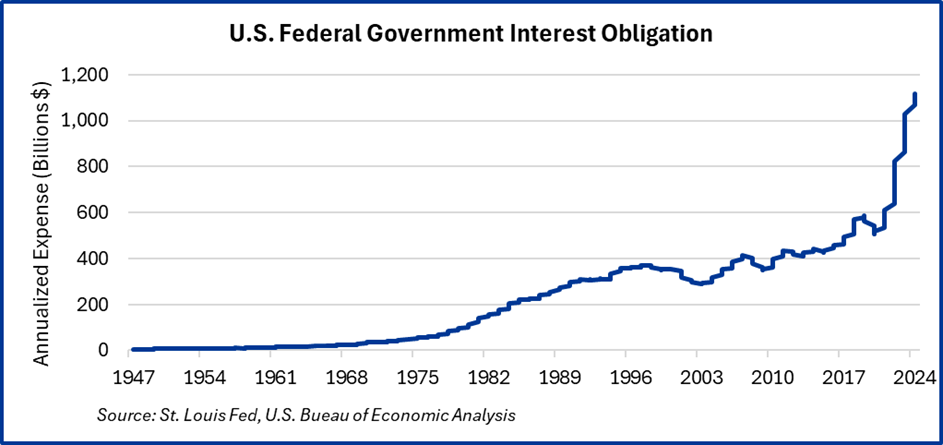
On September 18, the Federal Reserve finally reduced interest rates after kvetching about it for almost a year. This took the Federal Funds rate into a range of 4.75%-5% and started investors thinking about all the beneficiaries of lower rates. Unfortunately, because of the Covid crisis, everyone who wanted a much lower interest rate on their home or in their business had already financed for a longer term at rates well below where the Fed has now moved. The three primary beneficiaries of falling interest rates are the lower strata of incomes (where credit card debt is used), private equity, and the federal government. The latter two use shorter-term credit to a high degree, so that higher short-term rates have a big impact on their income statements. One need only look at the collapse of private equity deal activity or the federal government showing a roughly $1.1 trillion interest bill for fiscal 2024 (depicted below) to see where the stress points are. These groups should be the primary beneficiaries of lower rates.
A challenge of the Fed’s action to lower the overnight rate that banks lend to each other is that the banks are increasingly a smaller part of the United States financial system. In the not-too-distant past, traditional commercial banks were the dominant lender and their capacity to lend could be controlled simply by having them buy or sell securities from the Fed. In other words, if the Fed did not want the banks lending, they would simply have them buy securities from the Fed, which would reduce the banks’ capacity to extend credit. This also worked in the opposite direction if the Fed wanted the banks to lend more, as the commercial banks would be pressured to sell securities back to the central bank. Because the banking system dominated access to credit, the Fed had a much tighter leash on lending activity.
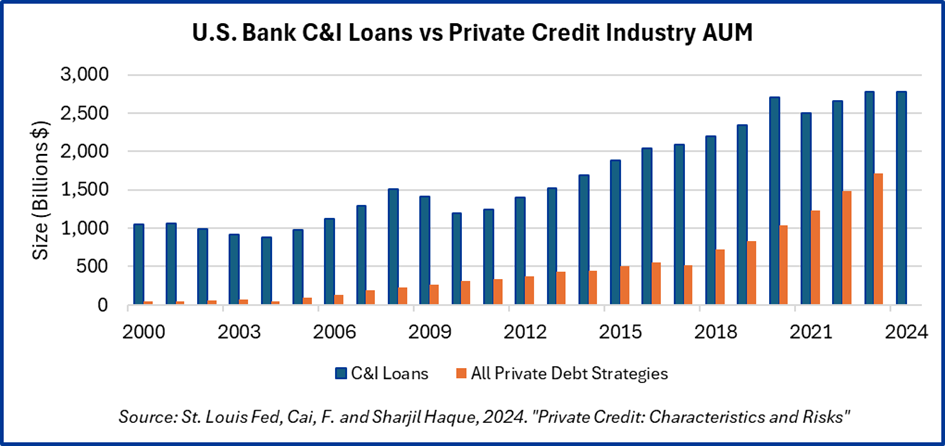
Comparing those Halcyon Days with today is to compare the National Football League with high school sports. While similar because it is the same game, the parameters are now so different that they are almost unrecognizable. Private credit is now being used aggressively within the private equity-backed sub-economy, and the asset class has become very popular. Empirical Research Partners (ERP) estimates this market at more than $1.6 trillion (graphed below), and this “shadow banking system” now originates loans that add up to 60% of Commercial and Industrial (C&I) loans made by major banks. Many of these loans are made with the idea that the loan is expected to fail. The reason being that the lender can then take equity in the defaulting company and earn a return greater than the 6% spread above a normal bank loan they were already receiving!
Federal Reserve policy cannot be ignored because it does skew the price of credit for a large part of the economy. Housing and consumer finance will have an easier time based upon the Fed’s recent action. But given the locked-in nature at low interest rates of large swaths of housing and corporate finance, we don’t see this initial cut making much of a difference. And when we consider how much less relevant the Fed is within the total economy because of the rise of private credit, the reduction is even less important.
Where it does make a difference is in determining the discount rate investors use to invest in stocks, real estate, and other investments. Higher interest rates drive prices down, and lower interest rates take prices up. This recent cut to interest rates is clearly a positive for valuations, even though it can easily be argued that it has already been accounted for in the run-up of prices over the last year.
The Debt Monster Stirs
We are not in the habit of looking at the price of insurance on U.S. government debt since it is just assumed that it is the “risk free security” in any portfolio. And while nobody has heard the term “credit default swap” since the financial crisis, this topic feels even more arcane. However, it was just pointed out by ERP that the price to ensure U.S. government debt is the same as that of Spain. Granted, the U.S. is the reserve currency for the global financial system. But it is also clear we have been abusing this position with a fiscal recklessness that is difficult to understand. We have commented before on the utter nonsense of Modern Monetary Theory (essentially a free pass for governments to spend whatever they wanted), but the combination of Covid spending and the failure to return spending to normal puts the country in a difficult position.
This Fed easing cycle began with federal government debt as a share of GDP at over 90%, compared to just over 30% in 2007. That deterioration in our fiscal position has resulted in a $1 trillion interest bill for fiscal 2024, an amount slightly more than the defense budget. With interest rates having moved up, this cost is going to continue to rise as compounding works in the opposite direction of a wise saver.
The “stirring of the debt monster” relates to the benchmark ten-year Treasury yield moving up since the Federal Reserve cut the regulated short-term Fed Funds rates. The first part of this note reinforced the difficulty of making predictions on the financial markets, and yields moving higher when the Fed says they should be going lower is a prime example. A $1.9 trillion deficit for this year with no plans to address the issue is starting to get the attention of investors. The Fed bought government debt during Covid (Quantitative Easing) but they have been gradually shrinking their balance sheet since that time. In our opinion, there is no chance that our elected leaders will do anything about this until there is a crisis. And history shows that crises are not good for asset prices.
Final Market Thoughts
2024 has been a remarkable election year because it created its own pattern. Policy was rarely mentioned, and yet, policy will have a big influence on tax and spending priorities as the 2017 tax law expires in 2026. The stock market has been very strong and is priced at a very high level. Federal deficits are large and there is no plan to address them, and interest rates are moving up. We cannot predict when the crisis will come, but it clearly is forming. Remarkably, the exceptional operating performance of the giant technology companies continues without interruption, and their share prices have followed. As we have previously written, their share demise will likely come from excessive capital spending. Their most recent earnings reports suggest that spending is now getting the attention of investors. Given the patterns of this year’s market are unlike anything we have seen before; we will not venture a guess as to how the post-election months will look. But the risks are very high, and triggers often come from places the market is not looking.
Resonant Capital Advisors, LLC (“Resonant”) is an SEC registered investment adviser headquartered in Madison, Wisconsin. This communication is limited to the dissemination of general information and, accordingly, should not be construed, in any manner whatsoever, as a substitute for personalized individual advice from Resonant. Always consult an attorney, tax or financial professional regarding your specific legal, tax or financial situation.
This communication contains certain forward‐looking statements (which may be signaled by words such as “believe,” “expect” or “anticipate”) which indicate future possibilities. Due to known and unknown risks, other uncertainties and factors, actual results may differ materially from the expectations portrayed in such forward‐looking statements. As such, there is no guarantee that the views and opinions expressed in this communication will come to pass. Past performance is not indicative of future performance. Investing involves risk, including risk of loss.
This communication may also discuss and display charts, graphs and formulas which are not intended to be used by themselves to determine which securities to buy or sell, or when to buy or sell them. Such charts and graphs offer limited information and should not be used on their own to make investment decisions.
Although all information provided in this communication is gathered from sources deemed
to be reliable, we cannot guarantee the completeness or accuracy of such information. The information should not be regarded as a complete analysis of any subject discussed. All opinions included constitute the authors’ judgment as of the date of this communication and are subject to change without notice.
For additional information about Resonant, please request our disclosure brochure as set forth on Form ADV or refer to the Investment Adviser Public Disclosure web site (www.adviserinfo.sec.gov). Please read the disclosure statement carefully.