Market concentration continues to be a major discussion topic in equity markets as Nvidia and the "Magnificent 7" continue to drive returns. The S&P 500 is now up over 15% year-to-date, but an election looms.
Rate cuts at the Fed's September meeting have now been handicapped with 100% odds by market participants, despite inflation that remains higher than the Fed's target range and tight labor markets.
High market valuations are not great predictors of near-term future results, but they do have a strong correlation to lower average long-term returns. We weigh this dynamic against other market and macroeconomic factors.
Second Quarter Recap
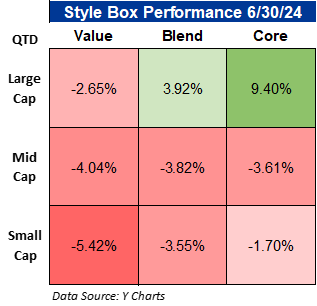
The second quarter of 2024 saw investors continue to support the theme of Artificial Intelligence (AI) that has dominated equity markets since the end of 2022. The AI infatuation has been led by the largest technology companies, and that has made for a stark difference between the performance of the large company S&P 500 and every other equity asset and sub-asset class. Morningstar breaks the U.S. stock market into nine “style boxes” to illustrate the differences in company size and management discipline related to value or growth characteristics (shown to the right).
During the second quarter, the only two boxes delivering a positive result were large blend (+3.9%) and large growth (+9.4%). All seven of the other categories declined by at least -1.7%. This divergence between the largest growth-oriented companies and investor enthusiasm for them, and everything else has a disproportionate impact on how one views investment results during the quarter.
The reason is simple: outperformance was impossible without an overweight to those sectors, and overweights to any area other than those two winners results in a negative return. And yet, simply buying the index and thus its disproportionate contribution from AI yielded favorable results.
Index returns reflected the AI impact outlined above. The S&P 500 rose 4.3% during the second quarter and is now up 15.3% for the first half of 2024. Medium-sized and small firms were not nearly as fortunate: the S&P MidCap 400 and SmallCap 600 fell -3.5% and -3.1% respectively, during the quarter. This took their respective six month returns to 6.2% and -.7%. The developed market MSCI Europe, Australasia and Far East Index (EAFE) fell a nominal -.4% for the three months and is up 5.3% for the year, while the MSCI Emerging Markets Index jumped 5.4% during the quarter to bring its year-to-date return to 6.1%.
Bond investors have been contending with a slow rise in the benchmark ten-year maturity Treasury bond yield. It started the year at 3.87% before rising to 4.21% on March 31 and finishing June at 4.34%. The Bloomberg Intermediate Government/Credit Index posted a .6% total return during the quarter and .5% for the six months, even as investors enjoyed the benefits of increased interest income for the entirety of the period. Municipal bonds were flat during the quarter and finished the six months losing -.1%. As described above, unless one was invested in the very largest companies (or emerging markets), it was nearly impossible to have earned a return during the quarter.
Whither Diversification
As described above, the stock market has become increasingly focused on just a few large technology companies that are directly involved in (Nvidia) or investing astronomical amounts of capital into artificial intelligence. We discussed Nvidia in our last quarterly letter, and it became even more important to the S&P 500 in the last three months, as it alone was responsible for 30% of the S&P 500 index return in the first half of 2024. When one adds in five more “Magnificent Seven” names (Microsoft, Apple, Alphabet (Google), and Amazon), approximately two thirds of the S&P return is accounted for. Because the S&P 500 is a capitalization weighted index, the larger the market value of a company, the higher its importance to the index’s return (positively or negatively). At one point in the second quarter, Nvidia became the most valuable company in U.S. with a market value in excess of $3 trillion after its 149% gain this year. In comparison, the equal-weighted S&P 500 index, which removes market capitalization and owns the index in “equal weights”, has risen only 4.1% this year. It really has been a year where diversification has been a major impediment to performance.
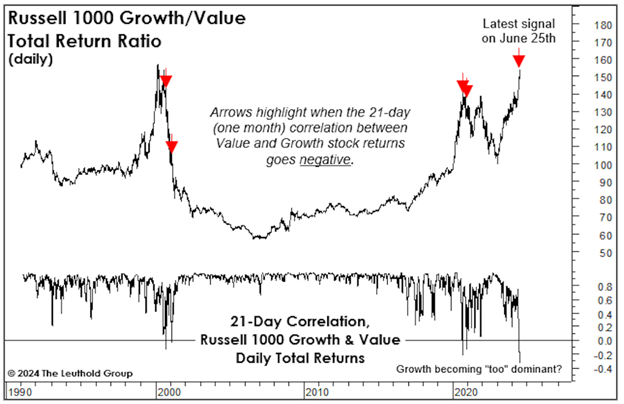
This theme of large technology company domination has been going on since the stock market reversed direction from its 2022 decline. After 18 months and the spectacular leadership of Nvidia, professional investors and experienced individuals are tiring of falling behind. Traditional rules of diversification (such as limiting commitments to sectors or individual securities) are being stretched if not abandoned by many market participants. The Leuthold Group points out that the correlation between large growth and large value stocks has become deeply negative. As shown in the chart below, this means that value stocks are being sold aggressively to buy the large growth stocks just as aggressively. This tends to occur at market turning points, though timing these events is inherently difficult. Our own barometer includes listening to clients, and one recently offhandedly suggested “selling everything and just putting it into Nvidia.” These are the types of events that we commit to memory as potential signs of a top in investor sentiment.
Source: The Leuthold Group
A Few Long-term Observations from Iceland
We have written often of the short-term orientation of humans in our modern world, especially because of the bombardment of stimuli from so many information sources. It is very difficult to discern long-term trends when one is constantly changing one’s mind based upon the latest newsworthy event. Likewise, our core beliefs and assumptions make us inflexible in the wake of monstrous societal shifts in investment. For older investors, the idea that just a few giant companies would come to be so profitable and so dominant compared to all other areas of the economy would seem far-fetched. Historically, as soon as a company became very large and perceived as exempt from competition, it would begin to falter. That is not occurring yet as the giants aggressively reinvest their abundant cash flow. The tech giants are not as likely to fail from neglect the way many of the previous giants have.
A recent tour around Iceland has us reflecting on how our basic assumptions can be challenged with clear evidence. A tour guide was a direct descendant of the Norwegians who first came to the island in 874-930 AD. They settled in an area that appeared fertile until the Little Ice Age emerged, and the area became glaciated before warming took place to bring it to its current state. What was most striking about our conversation, however, had to do with language. Those first settlers spoke “old Norse,” and a naïve assumption would be that it is closely correlated with present day Norwegian, and that Norwegians can easily converse with Icelanders. It turns out that Icelandic is so different from current Norwegian that the way he guides those from Norway is in the common language they both speak – English!
How is it possible that a common language between two groups separated by a relatively small sea changes so dramatically in 1000 years that they can no longer converse? While we have no linguistic awareness (perhaps this is routine), it does illustrate how without reinforcement of norms something dramatically different can emerge over time. Compounding can have fantastic results for savers as time goes by. We would postulate that the same can occur in the opposite direction if virtuous habits are slowly reversed.
We have for some time been expressing our concern about the reliability of the electrical grid in the United States. The reason for this is because of the routine closure of base load power plants in favor of renewable sources such as wind and solar. Besides the obvious prospective challenges of the wind not blowing or the sun not shining impacting reliability, there is also no reasonable way to store electricity in necessary amounts (demand) to replace the plants being retired (supply). Our belief is that brownouts and blackouts are on the horizon across wider swaths of the country as these trends continue to unfold. Historical standards of reliability will not be possible as more of the grid is dependent upon intermittent sources of power. Summer heat waves will be a likely trigger for this forecast to, unfortunately, be proven out.
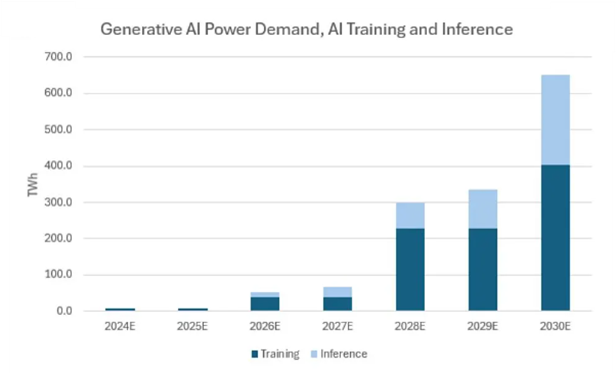
It is thus somewhat ironic that the electric utility industry sprung to life during the second quarter as investors became increasingly aware of the power demands that all these new AI-related server farms will require. AI-related consumption is expected to rise ten-fold (!) over the next two years, further taxing the vulnerable electric grid. The chart below displays this massive, estimated growth in demand for both the training of AI large language models and the inferences (content output) they make. The large technology companies are providing guidance that their emissions will increase above 30% annually as a result of these actions. While there are clear investment implications from these trends that we are trying to exploit, there is also the fundamental change from cheap and reliable electricity in favor of more expensive and less reliable power. If we are correct, consumers will likely not react well to this change. European elections are already reflecting citizen responses to surges in electricity prices. It is not an outsized assumption that this will one day impact Americans and thus our own elections.
Source: Wells Fargo
Back to Iceland: 99% of that country’s electricity comes from hydro power or from geothermal heat (the benefit of living on a volcano!). With a small population living quite close to each other, there is an abundance of electric vehicles as electricity prices are very low. But much like in the U.S., as soon as big tax credits for purchasing an electric vehicle expired, consumer demand waned directly. Regardless of expert forecasts and plenty of useful reasons for a real electric transition to occur, it is moving incrementally and not at the pace the planners imagined. A dose of humility for U.S. authorities would be wise given the very real and market-based lessons from Europe.
Economic Outlook and the Remainder of 2024
The Federal Reserve has taken no interest rate-related action thus far in 2024, and that has been a positive for the stock market, in our opinion. The current boom in prices started last November when the Fed signaled a willingness to cut interest rates multiple times this year. We thought this was a foolish forecast and have written about it in previous correspondence. Interest rates moving lower is a positive for stock and bond prices if all else remains equal, and the stock market responded to that.
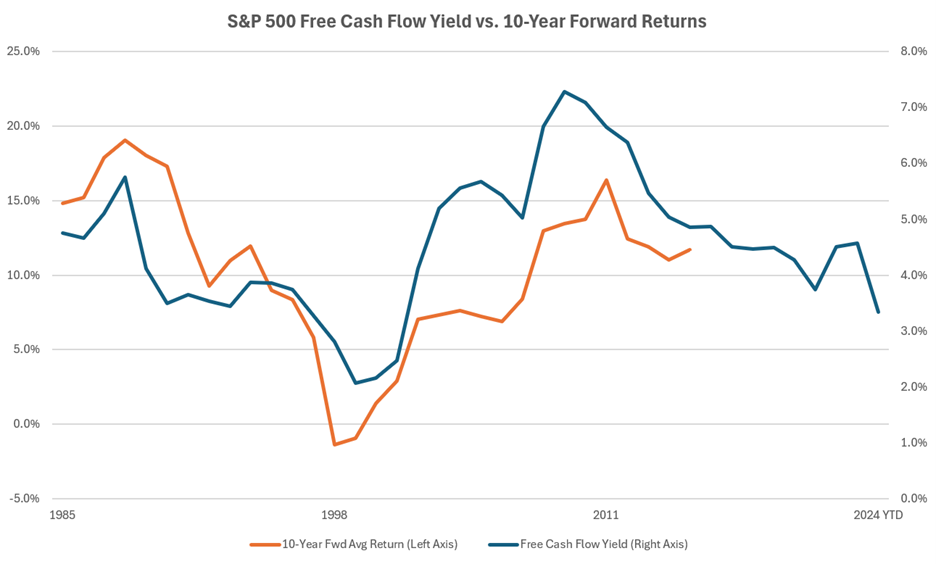
Unfortunately, the higher interest rates put in place over the last several years have noticeably slowed any activity tied to credit, i.e. the cost of borrowing money. We are seeing the impact of these higher rates across the economic spectrum. 60% of the population has signaled that it is impacting them. And higher consumer prices resulted from higher rates as companies looked to protect their top and bottom lines. The top 20% of the population is still feeling good about their economic circumstances because as net savers, they are benefiting from higher interest rates through increased yields on their capital. But companies more directly-tied to consumers not in the upper income strata are reporting poor sales and declining margins. Housing has held up primarily because owners are “trapped” in their low interest rate mortgages – they cannot leave because a new mortgage would be at a significantly higher rate and the lack of inventory is keeping prices high. Cash purchasers are often the buyer when properties do become available for sale because they can move quickly and without the approval of a lender. The sustainability of prices because of this dynamic is masking that housing asset valuations are similar to where we were in 2007, according to Federal Reserve analysis. When coupled with stock market valuations that are over 21 times expected earnings, we are at a poor starting point for a meaningful advance in asset prices. The following chart depicts this correlation, where lower current free cash flow yields (which implies higher valuations) among stocks have historically coincided with forward-looking periods of lower returns.
Data sources: Distillate Capital, Factset
With the unemployment rate having moved up to 4.1% and job switching waning, employees are not as confident as they were during the height of the employment shortages just a few years ago. The large wage gains of the last few years are still percolating through the financial system, and this is putting additional pressure on company profitability. Higher labor costs, poor consumer demand, and valuations that are high make us very cautious about the near term. Momentum in the big technology companies is bound to weaken, and where leadership emerges within the stock market will be the next question. The Federal Reserve appears likely to cut interest rates in September, now that inflation seems to be moving in the right direction. But cutting rates that close to a national election is a risky proposition, and lower rates are not always good for asset prices. History shows many instances where economic weakness that required a cut in rates was a precursor for poor earnings and a poor stock market. Without the AI boom, the remainder of the market is behaving in the subdued way we have been anticipating. The back half of the year is likely to have more volatility as these weaker trends become more accepted. And we have no reason to question the historical presidential cycle that suggests weakness leading to the election with a rebound into the end of the year.
Resonant Capital Advisors, LLC (“Resonant”) is an SEC registered investment adviser headquartered in Madison, Wisconsin. This communication is limited to the dissemination of general information and, accordingly, should not be construed, in any manner whatsoever, as a substitute for personalized individual advice from Resonant. Always consult an attorney, tax or financial professional regarding your specific legal, tax or financial situation.
This communication contains certain forward‐looking statements (which may be signaled by words such as “believe,” “expect” or “anticipate”) which indicate future possibilities. Due to known and unknown risks, other uncertainties and factors, actual results may differ materially from the expectations portrayed in such forward‐looking statements. As such, there is no guarantee that the views and opinions expressed in this communication will come to pass. Past performance is not indicative of future performance. Investing involves risk, including risk of loss.
This communication may also discuss and display charts, graphs and formulas which are not intended to be used by themselves to determine which securities to buy or sell, or when to buy or sell them. Such charts and graphs offer limited information and should not be used on their own to make investment decisions.
Although all information provided in this communication is gathered from sources deemed
to be reliable, we cannot guarantee the completeness or accuracy of such information. The information should not be regarded as a complete analysis of any subject discussed. All opinions included constitute the authors’ judgment as of the date of this communication and are subject to change without notice.
For additional information about Resonant, please request our disclosure brochure as set forth on Form ADV or refer to the Investment Adviser Public Disclosure web site (www.adviserinfo.sec.gov). Please read the disclosure statement carefully.