The markets surged ahead in the 4th quarter as investors acted on a perceived Fed pivot, and interest rates decreased. The rally was broad based, with small caps and value stocks moving higher alongside the large-cap growth cohort that carried the market in the first half of the year. The S&P 500 increased nearly 12% in the quarter and was up 26% over the full year.
After increasing their benchmark Federal Funds Rate from essentially zero to a range of 5.25-5.50%, the Fed adopted a "wait and see" approach, which the market interpreted as a directional pivot from its campaign of tightening monetary policy, to an easing stance. The resulting decrease in Treasury yields and interest rates supported buying in nearly every size group and sector of the equity markets.
A strong labor market has continued to keep the unemployment rate very low, and while headline inflation has subsided, we are not yet convinced that it will reach, and stay at, the Fed's long-term target of 2% given recent wage growth that has thus far proven to be sticky.
Fourth Quarter Recap
The financial markets exploded upwards in the final months of 2023, as investors assumed the Federal Reserve had completed their interest rate increase cycle. The S&P 500 Index of large stocks concluded the year with a 26.3% return after jumping 11.7% in the fourth quarter. The S&P MidCap 400 had a similar quarterly return of 11.7% and an annual return of 16.4%. Small stocks had a bigger bounce in the fourth quarter as the S&P SmallCap 600 advanced 15.1% during the quarter, which brought its full year return to 16.1%. International markets were also strong as the MSCI EAFE Index of developed markets moved up 10.4% in the fourth quarter and 18.2% for the full year. Finally, the MSCI Emerging Markets Index grew by 10.3% for the full year after a 7.9% increase in the fourth quarter.
Bonds staged a remarkable rally as the benchmark 10-year maturity Treasury bond had its yield decline from 4.57% on September 30 to 3.88% on December 31. This took the Bloomberg Intermediate Government/Credit Index to a total return of 4.6% during the quarter and 5.2% for the full year (bond prices move inversely with yields). The Bloomberg 1-10 year Municipal Blend Index advanced 4.6% for the full year after a 5.5% increase during the fourth quarter. Finally, the Bloomberg Commodity Index fell -4.6% during the fourth quarter, bringing its full year loss to -7.9%.
2023 Did Not Follow a Script
Unlike 2022, when our caution on economic and market dynamics was warranted as stocks and bonds had a terrible year, 2023 saw the opposite dynamic play out. The Federal Reserve was clearly not finished raising short term interest rates as 2023 began, and they did increase the Fed Funds rate another four times during the year to the current range of 5.25%-5.50%. For the S&P 500, early-year earnings expectations from analysts anticipated S&P 500 companies to earn $228 per share. By the end of December, those analysts were expecting S&P 500 earnings of $218 per share, a decline of -4.4%. We anticipated each of these policy and market actions, and anticipated that the result would be a challenging period for equity returns. And yet investors overlooked these as short-term concerns and drove stock prices up over 26% during the year.
Our third quarter letter went into considerable detail about the large “Magnificent Seven” companies and how they were skewing investor opinions of stock market performance. At that time those giant firms (Apple, Amazon, Alphabet (Google), Nvidia, Tesla, Meta (Facebook) and Microsoft) were responsible for 84% of the total return in the stock market. Our apprehension at that time concerned the herding of investors into just a few names, and the risk to the overall market if those companies were to stumble. While none of them retreated during the quarter, investor enthusiasm simultaneously broadened widely as the small and medium-sized stock indices saw sizeable upward moves during the same period.
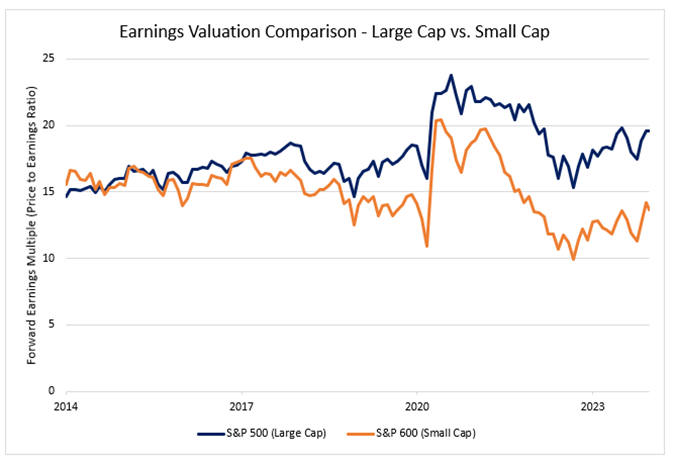
Assessing the information above at the start of the year (rising interest rates, falling earnings expectations, and investors crowding into just a few names), it was our opinion that the stock market would have a very difficult time in such an environment. Instead, the market had an exceptional year. We stated flatly in our Q3 letter that we were hesitant to reduce equity exposure further because the valuations on small and mid-sized companies were not unreasonable. This can be seen in the chart at the top of the next page, which compares forward price-to-earnings ratios between the S&P 500 and the S&P 600 SmallCap Index.
Source: Factset
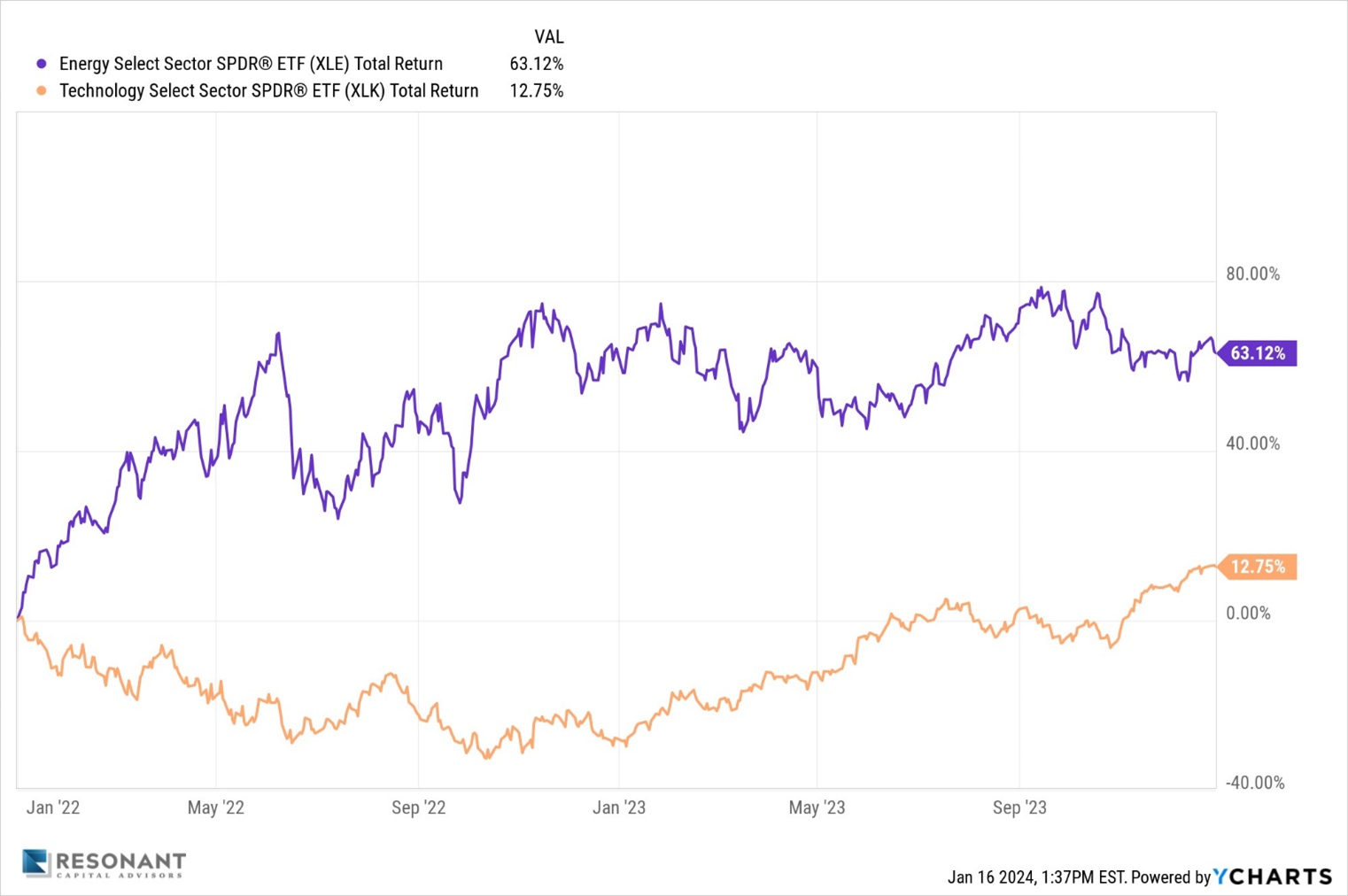
The conclusion we draw from 2023 was that we may have been accurate with critical parts of our outlook, but sometimes none of that matters when it comes to the price performance of the stock market. If most other investors saw the world just as we did, there was no unexpected surprise in the investment environment, and that meant there was no negative news for the market to react to. Anticipating investor reactions to information and news cycles is always a difficult task and we accordingly tend to stay away from making trading moves based upon very near-term assessments. The results of 2023 are a good case study of just how difficult this exercise can actually be. Another challenge we face is the exercise of working to earn a return in line with client expectations, while also minimizing the “collateral damage” of taxes. A primary example of this was the large allocation to the energy sector we made in our model portfolios during the pandemic. The collapse of oil prices and investor enthusiasm for an energy transition made the stocks within the energy sector very inexpensive at that time, and we took a meaningful position. In 2022, this was rewarded as the sector advanced by 65.7% (compared to technology which fell by -28.2%). As markets tend to do, a reversal of performance occurred the following year, as technology jumped by 58% and energy stagnated with a return of -1%. The simple math of those two-year returns put energy significantly ahead with a return over 63% compared to technology at 13%, which can be seen in the chart following this paragraph. Our default position is to move incrementally from what has worked into what has lagged, because the reversion to the mean between sectors tends to work over time. By moving incrementally, we also tend to avoid bigger capital gain liabilities in client portfolios. This strategy suits our investment personality well but is no less frustrating in a year where we were under-represented in the strongest area and over-represented in one of the weakest. Long-term investment returns are formed over more extensive periods than the one year increments we all tend to organize our own thinking around, but the 2022-23 period saw the market environment both give and take as it moved forward.
Source: YCharts
The Passing of Charlie Munger
Charlie Munger, the long-serving vice chairman of Berkshire Hathaway (pictured to the right), was one of the great investment minds in history. Warren Buffett referred to Munger for over a half century as his partner, even though they lived thousands of miles from each other in Omaha and Los Angeles, respectively.
Munger’s quotations and his thinking behind them fills multiple books, and we never tire of rereading what he applied himself and imparted to others. Munger passed away during the fourth quarter just shy of his 100th birthday, and The Wall Street Journal posted multiple links to previous interviews he had given to the paper. Many of these are laugh-out-loud funny, and all of them were filled with insights that can be used every day. Two of his favorite principles that we try and adhere to at Resonant involve the success he had with Buffett over their adult lifetimes. First, he suggested that they were successful because they were rational. Put differently, Berkshire did not chase fads or currently fashionable investments, but instead stuck to what they understood. Munger is credited with changing Buffett’s thinking on investing from looking for bad companies at outstanding prices to investing in great companies at fair prices. Much of the Berkshire portfolio today adheres to this strategy.
The second quality that Munger took very seriously was the flexibility and ability to change one’s own mind applying rigorous thinking to new facts, with basic curiosity as a prerequisite. A voracious reader, he relentlessly looked at problems from multiple points of view. By always challenging himself and others, he was much more likely to come to a well-reasoned conclusion that would also reduce the risk of error. It was a characteristic that we could all likely benefit from being reminded of. When asked what individual had the biggest influence on his life, he surprisingly suggested “(my) wife’s first husband.” For if they had not divorced, he would have missed out on a relationship that blossomed into a 56-year marriage. For resonant insights on investing and life, we cannot recommend enough any of the books and articles about and interviews with Charlie Munger.
Enough with the Fed Forecasting
One of the consistent themes of these letters is the futility of making short-term forecasts. We have been especially critical of those guessing when the Federal Reserve will be finished raising interest rates. Part of this assessment is that we simply don’t have that much confidence in the Fed to make an accurate forecast themselves, let alone extrapolating that investors will then also anticipate the Fed’s actions correctly. A good example of this was a “fireside chat” with Fed Chairman Jerome Powell on December 1st, where he suggested that the Fed would be paying close attention to the data in determining if they would be raising interest rates further. Within two weeks, the Fed Chairman was suggesting that they were finished with interest rate increases. The futures market immediately priced in up to six interest rate cuts during 2024! Much of the late-year stock and bond market rallies were grounded in this commentary and the resulting belief that interest rates would be coming down in 2024. Perhaps they will. And perhaps they won’t. But “knowing” this information is virtually impossible with any certainty, and would still likely be of little value as related to how the financial markets perform in 2024.
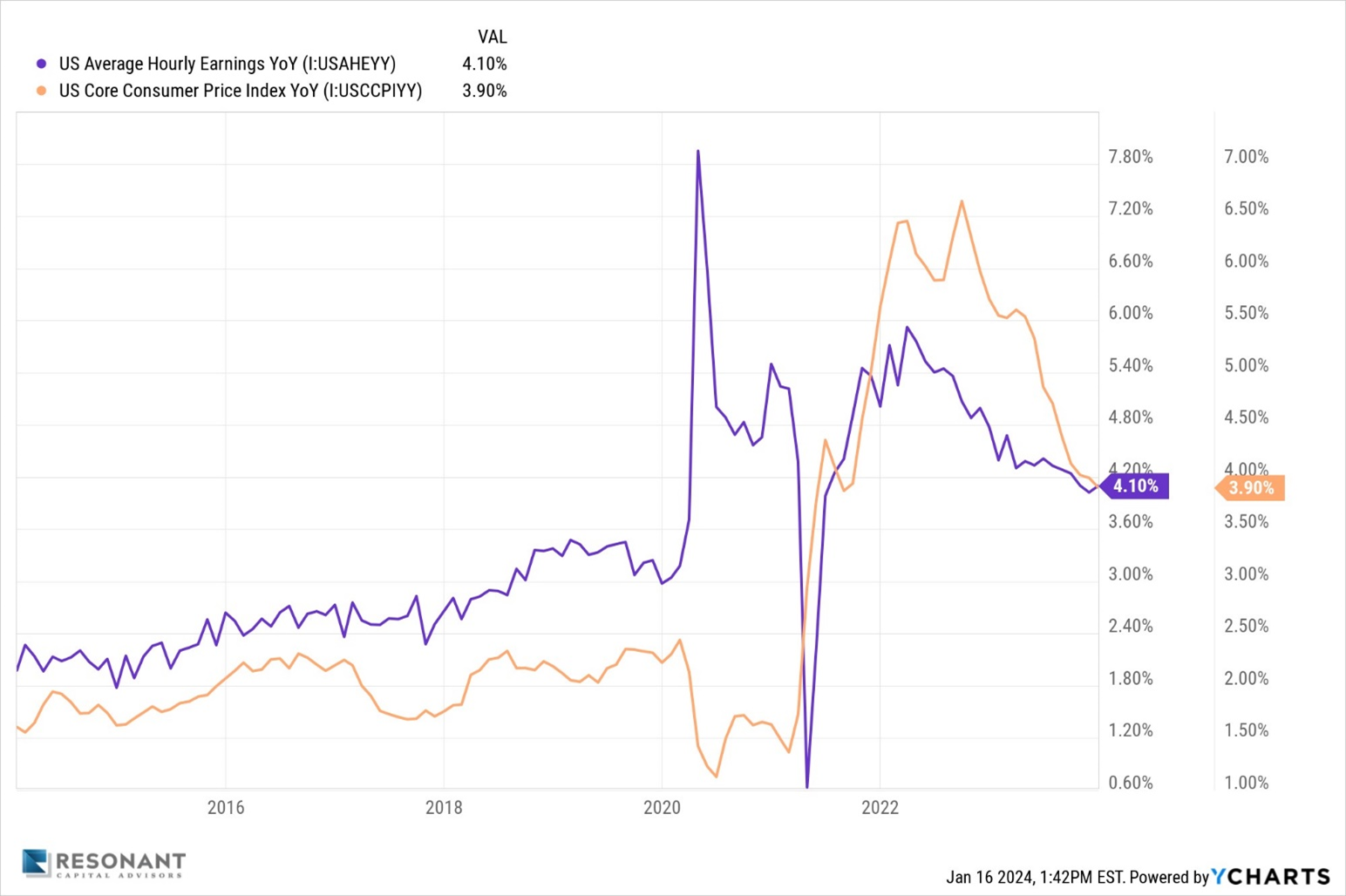
Interest rates will rise and fall based upon multiple factors, with inflation expectations, economic strength or weakness, federal budget deficits, and investors’ fear or greed being primary input variables. We are always puzzled by suggestions that a “neutral interest rate” is when the Federal Funds rate (controlled by the Fed) is equal to the inflation rate. What investor looks to defer current consumption so that they can consume the same amount at some time in the future? Isn’t the goal of deferred consumption to be able to consume more in the future? Yet a generation of investors has been led to believe that interest rates will remain low after inflation returns to the Fed’s 2% target. Again, perhaps they will, but we are not so sure. One only needs to see union contracts at UPS, the major auto companies, or all the airlines to see that the price of package deliveries, new cars, or an airline ticket are unlikely to be falling dramatically anytime soon. One of the reasons that consumer confidence does not reflect the low unemployment rate is that real wage growth after inflation has stagnated, a relationship displayed in the chart below. Our view is that all of the increases in the price of goods and services that consumers can actually see and feel is overwhelming the official statistics that show inflation has come down. Inflation will continue to fluctuate, but a consistent level below 3% appears less likely than the market is pricing in, given wage growth in the workforce.
Source: YCharts
Expectations for the New Year
Time flies, especially as we age, and that means we are once again in a presidential election year. We will avoid the histrionics of those making forecasts based upon the desire for eyeball clicks and focus instead on some of the patterns we have seen over time. Typically, the stock market will start to drift lower as the election cycle comes into focus. The reason for this is grounded in the inherent uncertainty of any given outcome. Once the election is over, the market tends to move up because the certainty of an outcome allows for investors to once again focus on what policy changes may be forthcoming. We realize this is not a groundbreaking insight (the market hates uncertainty and trades down, and then likes the certainty of an outcome and trades up). But that is likely to be the case in 2024 as it has been in prior presidential cycles.
Given how strong the stock market was in 2023 and our concerns about the likelihood that interest rates return to lower levels to support these higher prices, a pause in price increases should be in order. Valuations on the S&P 500 are not compelling at present, with the price/earnings ratio at 21 times trailing earnings. The crowding into the Magnificent Seven can certainly continue longer than expected, but new themes will need to emerge that capture the attention of investors. Small and mid-sized companies have advanced, with better performance recently as their more compelling valuations were recognized. We continue to be concerned about the banking system and lenders’ willingness to provide credit to consumers and businesses. Many companies have weakened balance sheets, and higher interest rates and less access to liquidity will likely put incremental pressure on a slowing economy. Like last quarter, we don’t see compelling reasons for outsized optimism. And just like last quarter, we recognize the futility of forecasting and don’t make major adjustments to portfolios based upon those expectations. Steering down the middle of the investment lane with broad diversification is the strategy we are most comfortable with, and at present we do not see a compelling reason to deviate from it.
Resonant Capital Advisors, LLC (“Resonant”) is an SEC registered investment adviser headquartered in Madison, Wisconsin. This communication is limited to the dissemination of general information and, accordingly, should not be construed, in any manner whatsoever, as a substitute for personalized individual advice from Resonant. Always consult an attorney, tax or financial professional regarding your specific legal, tax or financial situation.
This communication contains certain forward‐looking statements (which may be signaled by words such as “believe,” “expect” or “anticipate”) which indicate future possibilities. Due to known and unknown risks, other uncertainties and factors, actual results may differ materially from the expectations portrayed in such forward‐looking statements. As such, there is no guarantee that the views and opinions expressed in this communication will come to pass. Past performance is not indicative of future performance. Investing involves risk, including risk of loss.
This communication may also discuss and display charts, graphs and formulas which are not intended to be used by themselves to determine which securities to buy or sell, or when to buy or sell them. Such charts and graphs offer limited information and should not be used on their own to make investment decisions.
Although all information provided in this communication is gathered from sources deemed
to be reliable, we cannot guarantee the completeness or accuracy of such information. The information should not be regarded as a complete analysis of any subject discussed. All opinions included constitute the authors’ judgment as of the date of this communication and are subject to change without notice.
For additional information about Resonant, please request our disclosure brochure as set forth on Form ADV or refer to the Investment Adviser Public Disclosure web site (www.adviserinfo.sec.gov). Please read the disclosure statement carefully.