In Brief
- Equity markets closed the 4th quarter with another gain, marking a second blockbuster year in a row. The back-to-back 20%+ gains for 2023 and 2024 in the S&P 500 were the best two-year stretch since 1997 and 1998, buoyed by AI optimism and hopes that inflation has been tamed.
- As a new administration enters the White House with a likely full slate of intended policy changes, we examine the compounding policy errors that negatively amplified the outcomes of a recent tragedy and the European Union’s economic state.
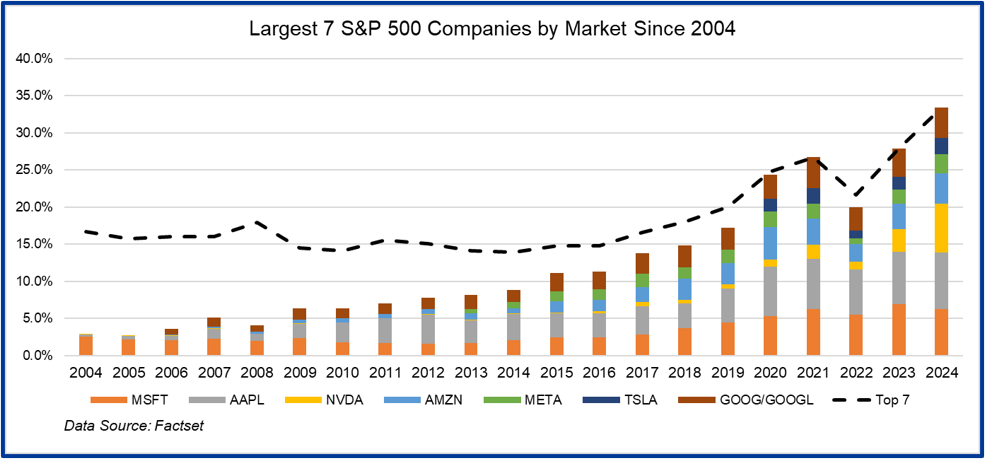
- The S&P 500’s exposure to the “Sainted Seven” is above 30%, a historically high level of concentration. As investors continue to price in a rosy future for the group, the companies in question have forecast substantial CapEx spending numbers that force us to question the likelihood of maintaining their profit margins.
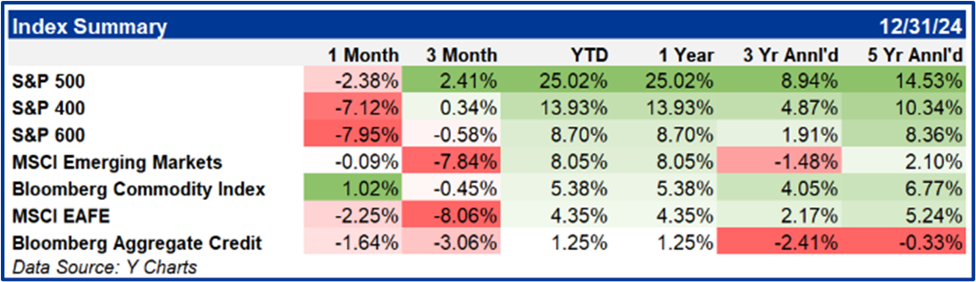
Financial results for 2024 are largely old news at this point, but it was still a spectacular year for the biggest technology shares as they carried the S&P 500 to a 2.4% quarterly total return and a 25% return for the full year. As has become customary, the medium and small sized companies lagged in their relative performance as the S&P Mid Cap 400 was up .3% for the quarter and 13.9% for the year. The S&P Small Cap 600 was down -.6% during the quarter and finished up 8.7% for the year.
International markets were subject to the shock of the U.S. dollar’s rally following the U.S. presidential election, which resulted in the Euro falling by 7% relative to the dollar. This headwind took the MSCI Europe, Australasia and Far East (EAFE) Index down -8.1% for the quarter and saw that index deliver a paltry 4.4% full year return. Developing economies fared a bit better as the MSCI Emerging Markets Index was down -7.8% during the period, bringing its 2024 return to 8.1%. The year-end weakness in international stocks took a good bit of shine off what had been a very solid year-to-date prior to the final quarter.
Fixed income markets saw a big rise in interest rates at year-end, as the benchmark 10-year maturity Treasury bond yield shot from 3.79% on September 30th to 4.57% on December 31st. This dragged the Bloomberg Intermediate Government/Credit Index down -1.6% during the quarter and shrunk its full year return to 3.0%. Tax-exempt debt, as represented by the Bloomberg 1-10 year Municipal Blend index, fell -1.0% in the fourth quarter and was up .9% for the year (pre-tax). Finally, the Bloomberg Commodity Index fell -.5% in Q4, but rose 5.4% for the year. These results are shown in the index performance summary below.
That Was Different
There is no shortage of superlatives to describe what the domestic stock market has delivered over the last two years. Indeed, the S&P 500 had its best two-year performance period since 1997-98. Initially benign positioning from the Federal Reserve saw steady rates followed by a fourth quarter interest rate cut, a contributing factor to stock returns. A steady economy with good corporate earnings helped as well. The Artificial Intelligence boom and the continuing strength of the megacap “Sainted Seven” technology stocks was a tailwind to momentum already in place. And the conclusion of the presidential election also likely played a part. Independent of the reasons, stock market valuations and investor sentiment have moved into speculative territory, where all news is expected to be good news and contrary trends are quickly shrugged off.
And it was not just the stock market that boomed. While we still have no real idea what one actually gets when you buy a Bitcoin, it doubled in price. Gold had a fantastic year, and saw its biggest calendar-year appreciation since 2010. The “Sainted Seven” of Microsoft, Amazon, Alphabet (Google), Nvidia, Meta (Facebook), Tesla, and Apple continued their upward march behind good earnings and monstrous cash flow. It has felt somewhat futile to wonder “How long can this go on?”, as they have defied all historically similar precedents in their march toward truly astronomical market capitalizations. But we feel confident that cracks in their armor are starting to emerge. Our thinking is outlined below.
First, the big cloud providers (Microsoft, Google, Amazon) are exploding their capital spending. This has long been the first sign that a stock will potentially run into performance trouble. It is not a hard and fast rule, but it is simply much more difficult to generate returns on new investments at the same level or higher as what you earned before. A lower return on capital going forward would be a natural reason for investors to become more skeptical. Nvidia is a different story in that they provide the hardware (chips) that power all activity in the global Artificial Intelligence ecosystem. We have previously written that all their competitors are now actively building as many chips as they can to get out from under the unlimited pricing power that Nvidia has had. The biggest risk to their remarkable enterprise may very well be contained in the recent announcement by DeepSeek about how that company has trained a competitive AI model at a much lower cost, i.e. using less of Nvidia’s chip technology. If this is true, Nvidia’s pricing power could recede quickly. And if companies slow down to evaluate their own circumstances, order patterns may shift from “I need it now” to “We will call you in a few months.” That would suggest a big change to the dynamics that have underpinned this market’s late-cycle momentum, and might shift investor expectations to something other than “euphorically optimistic.”
Whether any of this occurs in the near term is very difficult to predict. But we are highly confident that the market is not prepared for these changes. The simple reason is the remarkable degree of index concentration in these seven giant companies. Never before have we seen the risk of the U.S. stock market so closely aligned with the market value concentration in a relatively few giant firms. As we write about later, as a society we are incredibly fortunate to have the innovation that these firms have provided the U.S. and the world. But as investors, anyone putting money into the S&P has never had more of their dollars going into a small number of the biggest firms. We are not suggesting this is the end, but we do believe risk is heightened.
The Tyranny of the Experts Hits the Wall
One of the benefits of a slightly delayed year-end letter is that we can look back on January and revisit all of the unexpected events that were not predicted in the sea of investment missives that were done on a timely basis. When one considers what will happen in the remainder of the quarter and how it will likely dominate April reporting, we are wondering why a February letter never made more sense to us before.
There are two themes we want to explore in this section. The first is the Los Angeles wildfires and the second is our relatively sudden realization that Europe is now an economic catastrophe. Given that our clients run the entirety of the political spectrum, we have always been reluctant to be overly specific on policy. But the two events we are referencing have developed over an extended period of time only to surface incredibly suddenly. And in both cases, with a shockingly low level of competence in the delivery of services from the “expert class” of policymakers. Albert Einstein famously said “Compound interest is the eighth wonder of the world. He who understands it, earns it…he who doesn’t, pays it.” Unfortunately, continuously making bad decisions (however well intended) ultimately results in very bad outcomes.
Malcolm Gladwell wrote a chapter about the buildup of factors and decisions that contribute to plane crashes in his book “Outliers.” This work had a profound impact on us, and we have returned to it many times, over many years, and in a number of seemingly different circumstances. It is a useful framework for understanding how things that might seem extremely unlikely can occur, and how they might be explained. Gladwell argues that due to the remarkable web of aeronautic technology, operator training, scheduling structure and air traffic rules and oversight (among other things), planes don’t come down for one reason but for up to seven independent issues that go wrong. In isolation, the air traffic system can overcome most, if not all, of these challenges. But when combined, oversights or misunderstandings compound into errors, leading to tragic results. Unfortunately, we have had multiple recent examples of aviation catastrophes that have reminded us how relatively rare, but also how poignantly devastating these mishaps are.
In Los Angeles, the system in place for fighting fires proved to be inadequately reinforced and/or resourced. Challenges included empty reservoirs (due to extended maintenance and repairs), inoperable fire hydrants (including because of the shutdown of the electrical system that pressurized them), uncleared brush, human populations and power lines contributing to ignition, and the phenomena of the Santa Ana Winds preventing the airborne firefighting efforts necessary to overcome a ground-based system already-known to be inadequate in combatting wildfires of the scale seen in January. When all of these factors collided, a human and economic catastrophe ensued in an incredibly beautiful location. We were not immune to the devastation, as a number of friends and colleagues in our network suffered “only” terrible property losses, for which we and they are thankful.
Californians and those in Los Angeles are free to vote for who they want, but our guess is actual human and systemic competency is likely to be on the agenda in future elections. The state has the highest tax rates in the country, a shrinking population, and a long history of the expert class (state regulators) exerting a disproportionate impact on day-to-day life. Despite all of that, there was seemingly no ability to prevent, let alone manage, the Los Angeles wildfires. And now those affected citizens must turn to those who failed them for support in rebuilding their lives, homes and communities.
The European Union has long been viewed as being like the United States in that it is made up of Western-style democracies, but it is culturally much different. When the United Kingdom decided to exit the Union, it was largely to get out from under the regulatory rule of Brussels. Nothing has changed since that vote was taken in 2016, and the expert class in Brussels has continued to regulate European commerce to an extraordinary degree. For example, the EU is now mandating that all electronic devices like cell phones have a USB-C charging port. Now, this might seem to make sense as that standard appears to be in dominant market use – for the moment. But like all commercial products, cell phones and tablets will be subject to innovation and change, and a cartel of government bureaucrats has now frozen in time the capabilities of these devices.
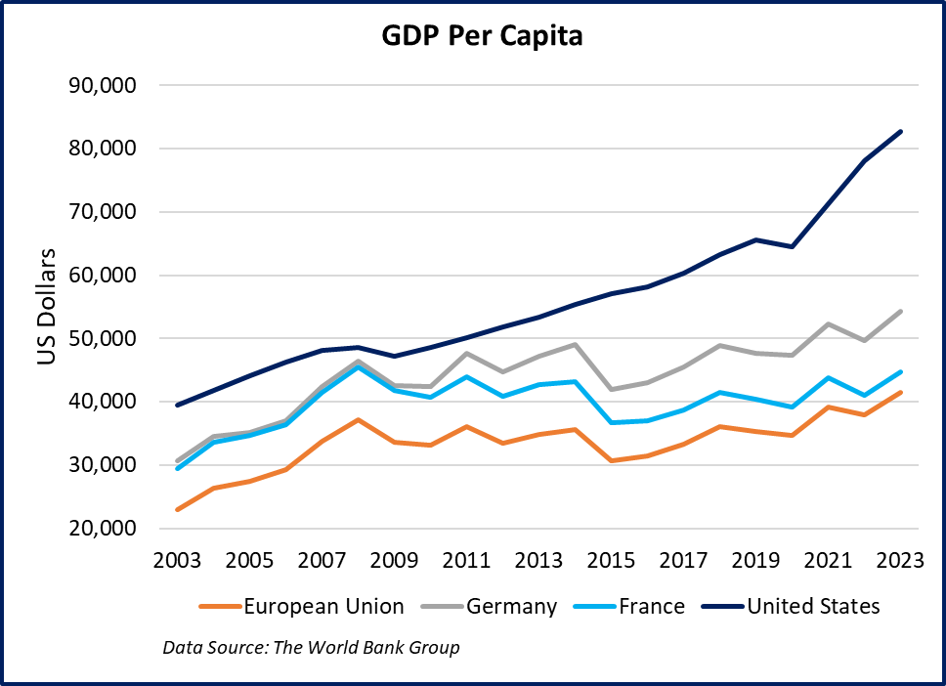
If you wonder where we are going with this, it can be summarized in the chart below. All of these well-meaning decisions add up over time and create an ultimately-sclerotic impact. Innovation dies and productivity improvements die with it. And without productivity improvements, incomes do not rise.
It is clear from the above discussion that those actions have had real world ramifications. It has been said that the “U.S. innovates, and Europe regulates.” Well, if your goal is to improve the standard of living for your residents it is quite clear whose model you should be following.
The investment implications have been disastrous for investors in European stocks. Diversification and relative valuations have always been the primary reasons for investing in European securities, but the negative compounding impact over an extended period is meaningful. Since July of 2007, the S&P 500 has compounded at a rate of 10.2% annually, while the MSCI EAFE index has compounded at a rate of 2.8% annually. The lesson here is that one cannot expect the status quo to continue without effort. Assuming the status quo will continue as a given is a fool’s errand, as everything is subject to change. The wealth and prosperity of the West has been built up over generations of work and toil, and it is a recent phenomenon that we both take it for granted and that it can be managed competently by experts. These assumptions are now coming under serious and well-deserved scrutiny, and if European policymakers begin to back away from their wealth destroying policies, the low valuations assigned to many of their securities could warrant a larger inclusion in our portfolios.
Outlook
While we don’t want to say we are excited about the bond market, yields have risen from their Covid lows to levels where positive returns have become more likely. Especially when compared with stocks that increasingly present limited value to the upside and in some cases, material risk to the downside. Balance is in order, given that there is more relative value in bonds than in stocks. When one considers the impact of “unexpected” policy changes from the new administration, we believe higher market volatility than we have seen in the last two years is a more-than-reasonable probability. And given the amount of concentration the major indices have in the biggest companies, the stock market could be subject to a substantial drawdown if the AI thesis is seriously questioned by investors.