Equities continued their march higher in the 1st quarter as investors maintained their hope for a Fed pivot, despite a move higher in Treasury interest rates. The 10% increase for the S&P 500 was its best 1st quarter return since 2019, and most other asset classes experienced positive returns with the exception of the bond market.
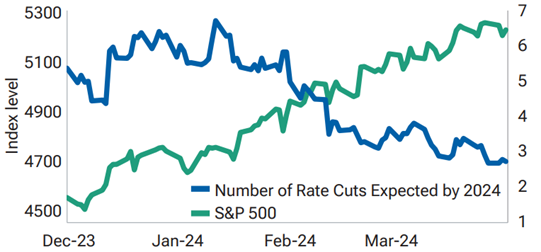
In the second half of 2023, investors began to raise their expectations for the amount, and size of, rate cuts. By December, market surveys were gathering that investors expected six or seven rate cuts, with those cuts beginning as early as March of 2024. As the previously positive inflation picture was clouded by a number of incrementally higher readings to start the new year, expectations for cuts were quickly tempered.
Given those stickier inflation readings, low unemployment, and a still-growing economy, it is harder to make the case for lower interest rates in the near-term. Paired with elevated equity valuations, we do not see the current risk-reward dynamic as overly compelling.
First Quarter Recap
The stock market raced to its best first quarter return since 2019 as the large cap S&P 500 advanced 10.6%. While the S&P MidCap 400 kept pace with a 10.0% return, the S&P SmallCap 600 eked out a paltry 2.5% increase. The MSCI EAFE International developed country index was up 5.9% and the MSCI emerging markets index advanced 2.4%. The bond market saw the ten-year maturity Treasury Bond interest rate increase from 3.88% on December 31, 2023, to 4.20% on March 31. This took the Bloomberg Intermediate Government/Credit Index down -.15%, and the Bloomberg Municipal 1–10-year maturity tax-exempt Index down -.37%. The Bloomberg Commodity Index finished the quarter up 2.2%.
Several factors came together to drive such strong stock market performance during the quarter. Interest rates and inflation, the expanding buildout of the artificial Intelligence infrastructure, the residual funds from Covid relief and the federal government’s expansionary fiscal policy, and investor willingness to pay more for a dollar’s worth of earnings all contributed. And the death of psychologist Daniel Kahneman was a good reminder of how we humans process disparate inputs.
Inflation and Fed Policy
Our year-end letter questioned why we should be paying attention to what the Fed was saying or doing, since they have clearly been wrong so often. The boom in first quarter stock returns is the best example we have as to why the Fed is important: Because markets move in response to the Fed’s directional guidance. By announcing that the Fed would cut rates multiple times in 2024, Fed Chairman Jerome Powell was perceived to be giving an “all clear” signal, i.e. that the central bank saw a more benign inflationary outlook and a reduced risk of higher interest rates. This was the “go time” bell for stock investors, and the subsequent rally has added over $10 trillion in wealth that is now supporting the economy.
Unfortunately, inflation has not cooperated as the Fed had hoped. We have been skeptical of this benign inflationary outlook for multiple reasons, with the tight labor market at the top of the list. A recent paper by former Treasury Secretary Larry Summers helped clarify additional challenges to the Fed thesis. In “The Cost of Money is Part of the Cost of Living”, Summers points out that current inflation calculations no longer contain the change in interest rates as a variable. But this shift has had a material impact on the economy for several reasons. First, the higher rate of interest has ballooned payments on any large expenditure (think cars and homes). Second and likely more importantly, consumer attitudes about the economy are much more closely correlated with the rise or fall in the absolute level of interest rates than with most other variables because of the immediate impact on cash flow and thus household budgets. Despite protestations from the Biden Administration that consumers should be feeling much better about the economy than they are (due to low unemployment and elevated asset prices), consumer and business attitudes about the economy are quite poor. The Summers paper does an exceptional job of explaining why.
Persistently low unemployment and stubbornly high inflation (greater than 3%) makes us even more skeptical that the Fed will actually lower interest rates at ANY time this year. The current data in these two areas are evidence enough. Considering that the back half of the year involves a presidential election cycle, it is easy to see the Fed taking the “safe” approach of trying to stay out of politics by not cutting rates as we get closer to election day. Market participants have started to accept this possibility, as illustrated in the following chart, but it has not derailed the climb in equities.
Survey Source: T. Rowe Price
Our final interest rate thought was well-summarized by J.P. Morgan CEO Jamie Dimon in his annual shareholder letter. He suggested the bank is ready for rates that could range “between 2% and 8%.” His conclusion is experience-based, and thus realistic, and it reflects the (in)ability of the world’s largest bank to accurately forecast interest rates. And as we have written previously, the unprecedented Central Bank intervention in monetary affairs for the last decade and a half has artificially suppressed interest rates from where the market would likely set them. This is not to suggest that policymaking during the Financial Crisis or Covid-19 periods were misplaced. Too much of a good thing, or its use by actors not as well-positioned, create differentiated outcomes. For example, negative interest rates in Europe and Japan were relatively futile, given basic expectations that one should be paid positively in exchange for deferring consumption. We continue to believe that market (the benchmark 10-year Treasury) interest rates will likely trend higher over this decade toward a more normalized level that exceeds the underlying rate of inflation. This might not be a popular view with those who believe the Fed has more wisdom than we do, but our job as investors is to evaluate the risks and communicate them to you accordingly.
Another Sage Passes with the Loss of Daniel Kahneman
Daniel Kahneman (pictured right) was an academic psychologist who won a Nobel Prize in economics for his work with his partner, Amos Tversky, on what humans actually do instead of what they are supposed to do. Much of economic and investing
theory is predicated on humans behaving rationally, and this baffled Kahneman as he saw people consistently making poor decisions. His leading subject was who he “saw in the mirror” when he reflected on his own irrationally poor decisions. Kahneman and Tversky’s work contributed materially to the now much-larger and better-accepted field referred to as “Behavioral Economics”. They thought of their subjects as humans, not simply as investors. We particularly appreciated their work on humans’ perceptions of gains and losses, and also their examination of how the “framing” of a decision could dramatically impact the actual decision itself. It is now widely accepted that humans value the joy of making $1 at a much lower level of intensity than that of the pain we feel from losing $1. And yet, when this decision is presented in terms of “making a gain” as opposed to “being exposed to a loss”, humans will more often choose the potential gain opportunity (even at a much different level of risk). These behavioral dynamics likely influence bull markets to climb higher and last longer than fundamental factors would suggest, but at a pace much slower than bear markets fall – as investors have a stronger incentive to avoid loss.
The framing conclusion is one of our favorites because it so closely dovetails with last quarter’s Charlie Munger tribute and his desire to “invert” problems to look at them from the opposite direction. While it sounds ludicrous, when subjects were asked which investment they would choose between “one that had a 10% risk of loss or a 90% chance of gain,” they overwhelmingly chose the gain. And they did this even though the odds were identical for both! How one phrases a question can have a profound effect on how the question is perceived, and also what the ultimate answer will be.
The practical application of Kahneman’s work can be simplified into the two ways in which we make decisions as illustrated in his tome, “Thinking Fast and Slow.” Driving and other routine tasks do not require in-depth analysis because we have done them before and thus the pattern recognition in our brains occurs very quickly. We use decision-making shortcuts to save time and energy, using what Kahneman would refer to as the “thinking fast” part of our brains. Intuition, impulses and emotions dominate this process. We have reasonable expectations, perform these tasks repeatedly and have a great deal of feedback to identify whether our decisions have been accurate or not.
Likewise, more complex tasks we haven’t done before require us to “think slowly” as we consider all of the things necessary to solve an unfamiliar problem. We have neither experience nor significant feedback related to infrequent decisions, so we are required to be deliberate, rational, and analytical. We are challenged by our own impatience and desire to make decisions quickly, even though we lack the experience to feel confident in our conclusions. This is especially problematic in the types of markets we have witnessed over the last four years. The Covid market of 2020 brought tribalism, social media, and an abundance of rapid trading decisions on individual companies. The market for very short-dated options on stocks has boomed as traders look for returns by using more of the thinking fast part of our brains and less of the thinking slow. This is not how we prefer to invest, but these very real dynamics can result in markets deviating significantly from underlying fundamentals and longer-term expectations.
AI and the Magnificent Seven Have Everyone's Attention
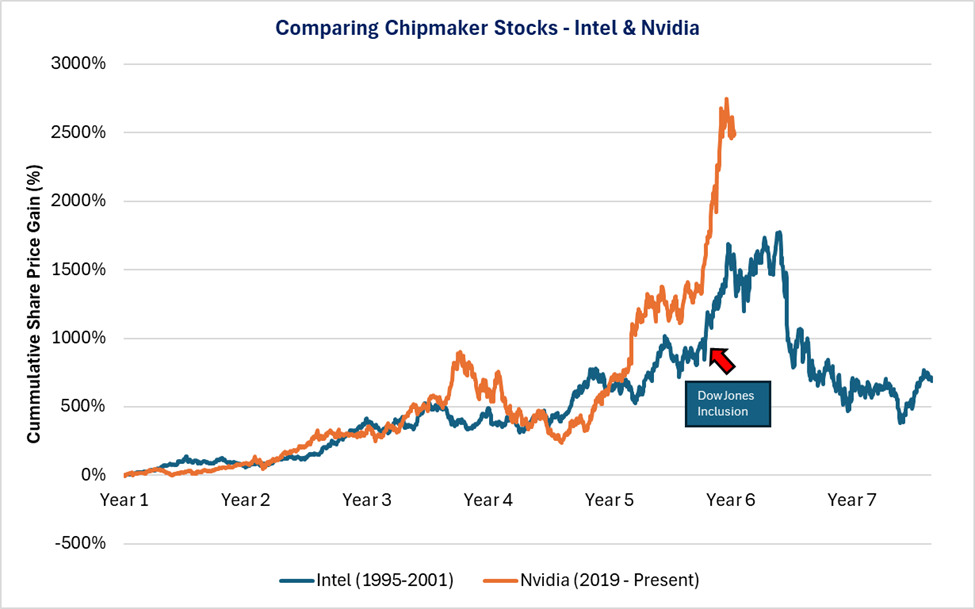
As chronicled above, our own biology, the electronic tools available to us, and the strong market have created a high reliance on short term thinking. Artificial Intelligence (AI) has been embraced by investors, and one of the companies involved in the build-out of AI is Nvidia. The company has been a recent market leader as one of the Magnificent Seven (the seven stocks that carried the stock market in 2023) and has recently attained a market value of $2.3 trillion. Nvidia may continue to perform and drive the S&P 500 Index higher, but we are becoming more skeptical about the opportunity it presents and what that means for the stock market. We see historical precedent in Nvidia’s ascension and possibly, what is to come for the stock.
In 1999 the stock market was in the middle of what is now known as the Tech Bubble. Internet-related stocks were appreciating with great price momentum but little earnings and cash flow growth. One of the dominant companies of that era was Intel, which quietly grew into the dominant supplier of the processing hardware that drove the PC and internet revolutions. Intel was considered such a blue chip company that it was added to the 30-stock Dow Jones Industrial Average on November 1, 1999. How did Intel perform from there? Adjusted for stock splits, Intel closed at $38.00 after reaching this pinnacle of the stock market. At the end of this most-recent quarter, the stock closed at $44.17, adding just 16% to its share price over the 24-year period since its Dow admission (excluding dividends). However, even those gains have been squandered after quarter-end as Intel closed the most recent trading day at $36.26. These marginal gains are not what investors expect in the future for today’s darling Nvidia. But it is very possible that its current $2.3 trillion market value has already priced in a good bit of the actual economic growth to come involving AI. Below we share a chart depicting the rapid rise of each stock, and the subsequent “leveling out” that occurred with Intel.
Source: YCharts
Successful investing involves both identifying the opportunity and then purchasing it for a reasonable price. Nvidia and several other Magnificent Seven stocks have continued to show outstanding sales and earnings growth, which have attracted the attention necessary to drive new investment into the company. But just like in 1999 (when a perceived shortage of networking hardware drove those suppliers much higher), the risk of inventory imbalances and new competition will ultimately swing sentiment from greed to fear in AI.
Fund flows are now also signaling that investors are very complacent in their belief that simply buying the S&P Index is the only strategy worth using. The Magnificent Seven stocks of last year became favorites because of their growth, but as they became a bigger part of the S&P, they made the S&P performance more dependent upon them. Vanguard reports that 27% of all global equity Exchange Traded Fund (ETF) flows in 2023 went into S&P 500-related products. The previous record was 22% in 2016, and in 2022 this figure was just 9%. While we would not call this a mania, we do conclude the financial performance of the big companies is vulnerable to disappointment and the flow of money into them is subject to reversal.
Casino Nation and the Role of the Expert Class
Jackson Browne wrote a song, Casino Nation, that attracted our attention for the title and not the social commentary it involved. The title seems particularly appropriate given the discussion of Kahneman’s decision-making research and also what we are observing in the financial markets. Legalized sports betting is a rapidly growing “new industry,” now favored as politicians seek to raise revenues from what had previously been underground sources (while conveniently ignoring the societal challenges and other inherent conflicts). Legalized sports betting technologies are structured similarly to casino games. These structures tend to obfuscate actual probabilities and thus obscure the relative strength of one’s counterparty. If we look at who is participating and to what degree, it reinforces Kahneman’s conclusions as well as the futility of much of our behavior.
Participation in sports betting appears to increase with educational level – meaning college-educated bettors participate more than the general population. As per Kahneman, the more experience we have in an activity, the greater the familiarity with and affinity we have for other participants, the more we believe we are “expert” in a field the more comfortable we are in speculating on outcomes. Unfortunately, we don’t become more proficient at the activity as we do it more, but our confidence in what we are doing increases, and we also seek to do it more often. Short-term, dopamine-based feedback loops create enthusiasm independent of outcomes. Whether it be in social media participation, stock speculation or sports betting, the more we believe we can predict short-term price changes the more likely we will be incorrect. As baseball star Shohei Ohtani’s felonious interpreter, Ippei Mizuhara, said to his bookmaker in 2022 “I’m terrible at this sports betting thing huh? Lol.” Having humility about our capabilities is an important tool in the risk management of these activities, and thinking slowly and carefully about our odds of success is a superior strategy than acting impulsively.
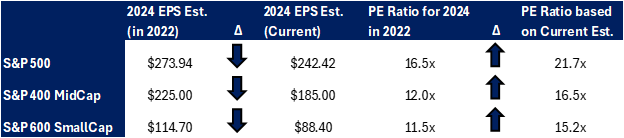
We conclude with a bit of math to try and illustrate how market valuations have expanded over the last several years. The table below shows expected earnings in 2024 for our three preferred domestic stock market indices (the S&P 500, MidCap 400, and SmallCap 600) in 2022 and currently:
Source: Factset
There are two conclusions we will point out in the expectations for 2024 earnings and how investors are pricing those earnings. First, in all areas of the market, earnings expectations over the last two years have consistently fallen. Based upon the March 2022 price and the expected earnings in 2024, the price/earnings ratio for each index was valued within the normal band of expectations. When we fast forward two years, the S&P 500 has appreciated 16% while the expected earnings for the index in 2024 have fallen by 11.5%. And this has happened as the 10-year maturity Treasury bond yield expanded from 2.32% to 4.2% during the same period. Falling earnings in the face of rising interest rates is no surprise. The unexpected event is investor willingness to reward both of these inputs with higher valuations. While the mid and small company indices are still in the normal range, we are much less enthusiastic about the S&P 500 trading close to 22 times expected earnings.
Conclusion: Risks Abound from High Expectations
Inflation has been stubborn and not measured properly related to how consumers feel it in their everyday lives. Interest rates are climbing to reflect this, and the Fed is likely to leave regulated interest rates where they have been because unemployment has not moved higher as they expected. Corporate earnings have not improved and in fact have not grown as they had been expected to over the last two years. Because stocks have risen in price, their valuations have expanded, and this makes them vulnerable to a change in investor perception or the larger economic narrative. Daniel Kahneman would tell us not to assume prices will keep rising simply because they have been rising and to think things through carefully. This takes us to the conclusion that risks are higher because we can see that the margin of safety is smaller.
Resonant Capital Advisors, LLC (“Resonant”) is an SEC registered investment adviser headquartered in Madison, Wisconsin. This communication is limited to the dissemination of general information and, accordingly, should not be construed, in any manner whatsoever, as a substitute for personalized individual advice from Resonant. Always consult an attorney, tax or financial professional regarding your specific legal, tax or financial situation.
This communication contains certain forward‐looking statements (which may be signaled by words such as “believe,” “expect” or “anticipate”) which indicate future possibilities. Due to known and unknown risks, other uncertainties and factors, actual results may differ materially from the expectations portrayed in such forward‐looking statements. As such, there is no guarantee that the views and opinions expressed in this communication will come to pass. Past performance is not indicative of future performance. Investing involves risk, including risk of loss.
This communication may also discuss and display charts, graphs and formulas which are not intended to be used by themselves to determine which securities to buy or sell, or when to buy or sell them. Such charts and graphs offer limited information and should not be used on their own to make investment decisions.
Although all information provided in this communication is gathered from sources deemed
to be reliable, we cannot guarantee the completeness or accuracy of such information. The information should not be regarded as a complete analysis of any subject discussed. All opinions included constitute the authors’ judgment as of the date of this communication and are subject to change without notice.
For additional information about Resonant, please request our disclosure brochure as set forth on Form ADV or refer to the Investment Adviser Public Disclosure web site (www.adviserinfo.sec.gov). Please read the disclosure statement carefully.