The first quarter of 2023 saw stock and bond markets rallying through a banking crisis as multiple banks failed due to the mismanagement of risk and asset-liability functions. The market saw highly-divergent returns over the quarter, with the largest tech stocks spiking.
We look at several topics important to Resonant Capital’s thinking and apply them to the most recent period in the markets: the passing of investment manager Steve Leuthold, Nassim Taleb’s The Black Swan and The Tao Jones Averages.
Our analysis of Silicon Valley Bank’s failure is looked at through a classic Coen Brothers movie and the difference between being an investor and being a bank lender. We look at areas where “The Everything Bubble” may still present risks for banks.
We remain cautiously positioned in an environment of continuing inflationary pressures, a competitive employment market with increasing wage rates, and declining earnings which could pressure a stock market with expensive valuations.
First Quarter Recap
The first quarter of 2023 continued the trend of increased volatility in the financial markets. This was highlighted by stock and bond markets both rallying through a banking crisis. The latter challenge saw multiple bank management teams stumble in their execution of straightforward risk and asset management functions, a point we will return to later in this commentary. Signs of a slowing economy reversed several investor preference trends of the last year as growth stocks rallied and dramatically skewed index returns. The total returns for the various indices we always measure ranged from 7.5% for the S&P 500, to 3.8% for the S&P MidCap 400, to 2.6% for the S&P SmallCap 600. International developed markets rose 7.3% while emerging markets posted a 4.0% return. Bonds were positive as the yield on the ten-year maturity Treasury bond fell from 3.88% on December 31, 2022 to 3.49% on March 31. The Bloomberg Intermediate Government/ Credit Index rose 2.3% for the quarter, the Bloomberg 1-10 Year Municipal Index rose 2.0%, and the Bloomberg 1-3 Month Treasury Bill Index returned 1.1%. The one exception to the rising prices of financial assets was a decline of -5.4% in the Bloomberg Commodity Index. There was some irony that all of this positive news came as the Federal Reserve raised the regulated short-term Fed Funds interest rate from an effective rate of 4.33% on December 31st to 4.83% on March 31st.
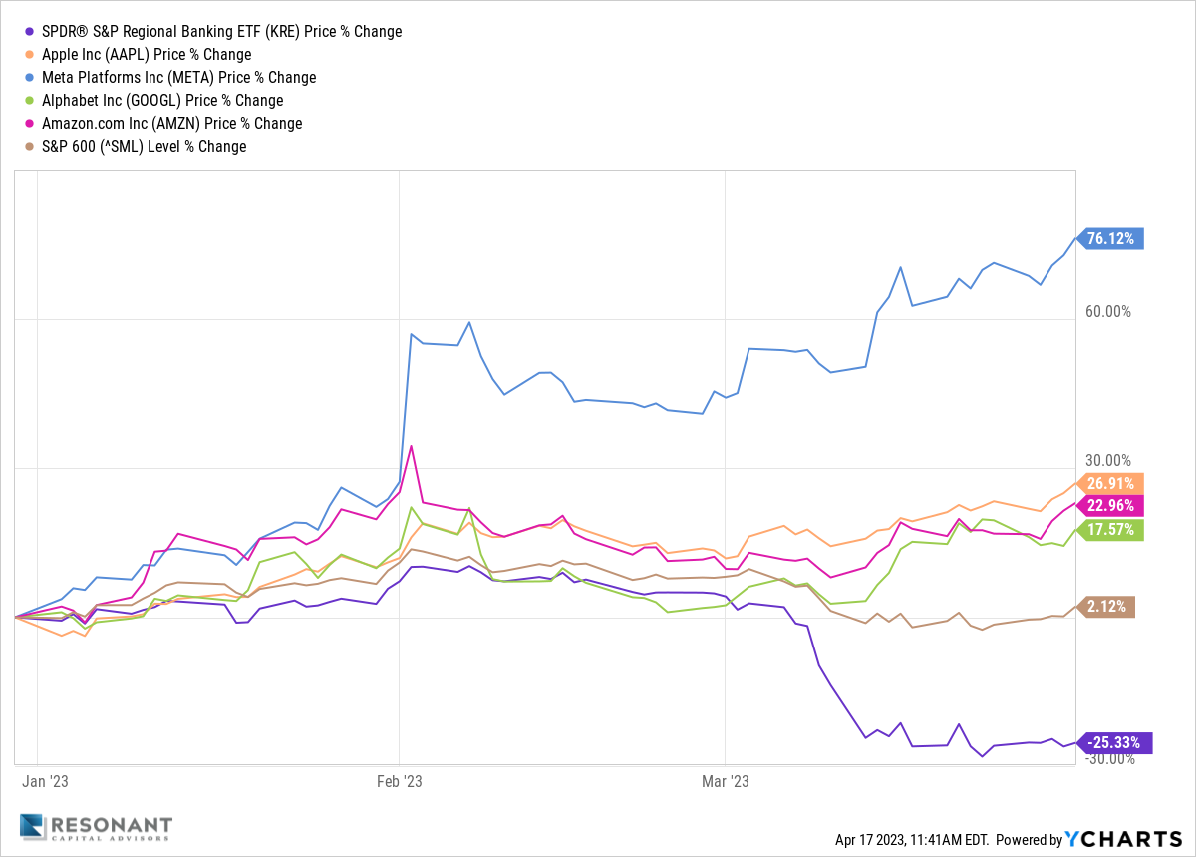
Beneath the surface of these markets was a much higher level of angst than one could imagine from the calm appearance up above. Volatility is a term overused and poorly understood by the financial press, as it is commonly used only to highlight declining markets (a rising market is evidently just an expectation). During the first quarter, the small stock S&P 600 rose 13.8% from December 31 to February 7 before falling -14.3% from February 7 to March 23. It rose 4.8% in the last week to finish the quarter with the benign 2.6% return referenced above. Even more meaningful to investor perception was the spike in returns for five of the largest technology stocks during the quarter. Apple rose 27%, Amazon increased by 23%, Microsoft advanced 20%, and Google (Alphabet) lagged with a paltry 17% gain. All of these were vanquished by the 76% jump in Facebook (Meta Platforms) as the company learned that firing 10,000 employees would be greeted enthusiastically by investors. These five companies were the primary drivers behind the large company S&P 500 besting all other indices during the first quarter. Incredibly, this added $1.577 trillion in market value to those five companies while bank failures were harkening back to the days of the 2007-09 financial crisis. In fact, we find it bizarre that these types of confidence-inducing returns could come in the face of a decline of -25% in the SPDR Regional Banking Exchange Traded Fund. We provide a visual of these market dynamics above. It is very difficult to imagine an environment where such divergent returns are possible, let alone easily explainable.
Steve Leuthold, Black Swans, and the Tao Jones Average
Paragraph headings normally alert a reader about what is to come, and we recognize that this heading appears to be a random collection of words. But all these people/books have had a meaningful impact on how Resonant Capital views the financial markets.
Steve Leuthold, at left, was an investment manager in Minneapolis who died recently. Steve was a trailblazer in investment thinking who was defined by the twin qualities of being comfortable as an extreme contrarian and never taking himself too seriously. His firm publishes their research work each month in green-bound volumes titled “Perception for the Professional”, commonly referred to as
“The Green Book.” Historically, investment firms used client trading commissions with brokerage firms to “pay for” research by diverting commission payment “soft dollars” to research providers. The Green Book was a must-have resource for portfolio managers and analysts. Now that stock commissions are no longer paid to firms' primary custodians, Resonant pays directly with “hard dollars” for the few investment publications we believe are worthwhile. And because we have some money managed at Leuthold, they still indulge us by sending the monthly Green Book.
One of the features of The Green Book was Steve’s “View from the North Country.” It often had crazy off-color stories, and always included a “joke of the month” submission from readers. All of this within an exceptional investment publication in an industry that historically has taken itself far too seriously. Steve’s passing prompted us to remark on his legacy, part of which is reflected in Resonant’s light-hearted references to popular culture within the Resonant Review and otherwise. That legacy is carried on in his firm, which continues to do good work with terrific people and an enduring culture, all touchstones for Resonant. And it’s encapsulated in his obituary, which represents him well and that readers can find here.
Nassim Taleb wrote the book The Black Swan, and it was fortuitously published on January 1, 2007. It details how poor humans are at anticipating what we perceive to be improbable events. Taleb’s work is supported by exceptional research into behavioral economics, decision-making and choice architecture by Daniel Kahneman, Amos Tversky, and Richard Thaler (among others). The Great Financial Crisis soon imploded the global economy, and many steps were taken to address the previous excesses that were at the root of the crisis – specifically the role of banks. For over a decade we have been subjected to “stress tests” on banks that are administered by the Federal Reserve to ensure that these institutions are prepared for various threats to their business. The failure of Silicon Valley Bank has prompted much “gnashing of teeth” regarding what was missed by regulators and auditors. None of this is a surprise to us because as Taleb so artfully exposed, misevaluating large risks that are around and in front of us every day is actually a feature of human nature.
The Tao Jones Averages was written in the early 1980’s as a guide to “Whole Brain Investing.” Unlike so many books on how to make money in stocks, author Ben Goodspeed emphasized human behavior and the biases we all have that work against our success. Much of human decision-making is based in pattern recognition – we identify and assemble data points toward a conclusion more easily when we have seen something previously. Goodspeed clearly enjoyed making fun of bright MBAs doing extensive regression equations to extrapolate past events into the future with ever-higher levels of precision and conviction. The problem with this approach is that patterns repeat themselves until they abruptly do not. Whether it is Taleb suggesting humans have poor imaginations about what is to come, or Leuthold always looking to be out of the consensus, or Goodspeed emphasizing how greedy or fearful we are around certain investments, a takeaway lesson is that humans tend to make the same mistakes over and over again. This places the Silicon Valley Bank (SVB) debacle in a different setting and makes the events that precipitated and followed it a good bit more logical, if also more unsettling.
The Fed, Congress and the Executive Branch all Collaborate to Unintentionally Fail
In our last quarterly report, we detailed our frustration with the rise of the expert class in our society. Common sense and hard-won knowledge as the result of experience have been supplanted by a credential threshold that conveys a subjective right to offer an opinion.
For a decade, anyone reading our correspondence has been treated to a quarterly repeat that included our suspicion regarding the low rate of interest paid on bonds, and our absolute skepticism that bonds were a worthwhile asset class to make a balanced or overweight allocation to. Much of this was due to the Fed’s suppression of short-term interest rates, but we also did not believe the risk/reward in buying longer-term bonds made any sense. We often say we are “chicken bond investors” at Resonant, meaning we don’t want to risk principal loss from lending to poor credits, or from lending for too long in a low interest rate environment. The public was made aware of these risks very abruptly with the collapse of SVB. Why? Because the bank’s management team clearly lacked understanding of the basic responsibilities of a bank that wishes to remain solvent: Matching the duration of its assets to those of its liabilities. SVB management was clearly incompetent, but they were also a victim of their own lack of imagination. They would have done well to have taken the lessons of the authors above to heart, particularly as their core function hadn’t changed AND they were operating in the unprecedented monetary policy environment created by the Fed that went on longer than any time in history.
We blame the monetary and fiscal policies in Washington for producing the excessive monetary stimulus that created the “everything bubble” in asset prices and an ignition of inflation. SVB was surfing on cash that flowed into venture capital funds and startup companies in the wake of Covid-induced stimulus and the speculative environment that followed. As the Fed withdrew quantitative easing by letting their portfolio of government bonds mature, that government debt had to be bought by someone. Low interest bank deposits flowed out of the banking system and into Treasury debt. This occurred rapidly and to the degree that a banker friend asked the rhetorical question: “Why am I being asked to solicit deposits for the first time in my 30-year career?” Meanwhile, a larger regional bank was quietly looking to sell loans to competitors.
SVB had poor diversification in their deposit base, and so it was also subject to a bank run created by Twitter postings from influential VCs and private equity investors. Their final undoing was the crazy notion that losses on long-term bonds held until maturity did not have to be marked down to the lower market value that resulted from higher interest rates! Was this idea just another reckless abuse by a poor management team at a self-serving bank? No! It is official accounting used by regulators in conducting bank stress tests. After all the regulatory scrutiny, the Dodd Frank law, and audit firms blessing the financial statements of SVB, it still failed in a matter of days because of a stress test that did not imagine such an obvious potential outcome. All the experts failed again.
We're Not a Bank, Jerry
Jerry Lundegaard is the hapless car salesmen in the Coen Brothers’ classic dark comedy film Fargo. His exchange with his father-in-law and an advisor regarding an investment opportunity was memorable because it clearly illustrated the difference between being a lender and being an investor. When his father-in-law’s partner finally figures out that Jerry
(seen at right, played by William H. Macy) wants a loan and not a finder’s fee, his response in Minnesota twang is “We’re not a bank, Jerry.”
Having spent a good part of our careers at a bank, we can speak about what works and what does not work in banking. What works is being very conservative and keeping your costs down. What does not work is thinking like an investor. The simple reason is that bankers do not capture the upside of being an owner if a loan goes well, but they are exposed to all of the downside of the underlying asset if a loan goes poorly. If it feels like we have seen this before, it is because it happens routinely over time and in every business cycle. And no amount of regulation will change this. The best banks to invest in are those where all the customers complain about how difficult it is to get a loan. Investors should run and hide from investment opportunities in quickly growing banks.
“Anything that grows that fast is a weed” is another expression passed on from a retired money manager, and SVB certainly qualified. It was a bank where the management had a poor understanding of what the business of banking was and what the risks were in managing the business. They were the first institution to fail this cycle as they were the most egregious example of excess within the banking industry, but they will not be the last. Mid-sized banks have been a primary source of credit in the commercial office market, and we see this as a major area of risk.
We are concerned about higher interest rates being placed on properties that do not generate sufficient cash flow to service the debt. The effects of these higher interest rates are already being seen. The Wall Street Journal has written multiple times recently about the owners of over-levered office and apartment buildings turning the keys to those properties over to their lenders. This will continue for several years as interest rates normalize at levels reflecting the inflation that is increasingly embedded in the economy. As an example, Delta Airlines pilots recently agreed to a 34% increase in wages over the next four years. Wage inflation is a reaction to price inflation, but then they become partners as wage increases sustain price increases in a very difficult upward price and downward economic spiral. The hangover from the “Everything Bubble” is likely to last longer than just a few months.
Unemployment and Earnings are the Next Chapters
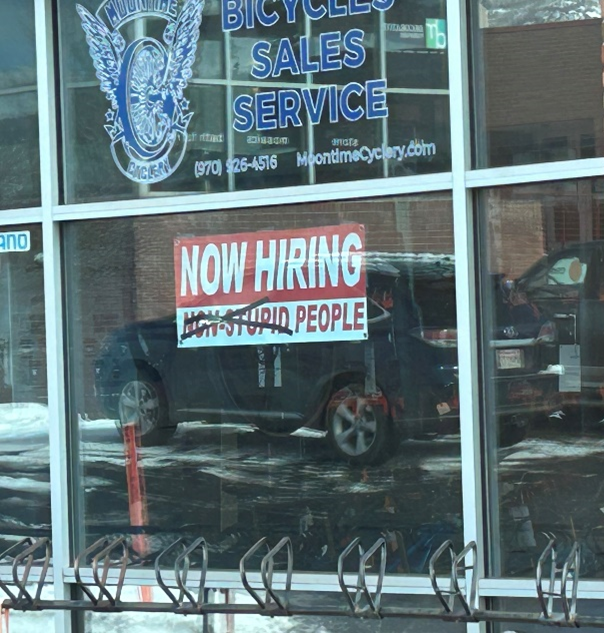
The photo to the left of a bike shop in Edwards, CO is telling for the employment situation in the United States. Regardless of the reason employees are in short supply, wage rates have continued to be under upward pressure as employers compete for workers. The Fed is acutely aware of this dynamic in their effort to reduce inflation and has been historically aggressive at raising short-term interest rates. We do not believe the Fed will contemplate reducing interest rates until we see a material increase in the unemployment rate.
And a higher unemployment rate means a slowing economy and lower corporate earnings.
Investors have been slow to recognize this dynamic as stocks moved up nicely during the first quarter. But much of the increase came from five big technology companies referenced above. Given that Microsoft currently is valued at 29 times this year’s estimated earnings and Apple is at 26 times, we find it difficult to believe that this performance is sustainable or repeatable. It is far more likely that expensive valuations and a declining earnings environment will make it more difficult for the stock market. The reprieve in stock prices has come from a liquidity infusion from the Fed into the financial system in the wake of SVB. The cash made available to banks after SVB is exactly what the Fed
should be doing and what was behind the idea of a central bank in the first place. All of the interest rate manipulation they have indulged in over the past decade should be eliminated from their playbook, because it is increasingly clear that this fine-tuning has had unintended consequences and yielded poor results. We expect the debate about the Fed’s efforts to suppress long term interest rates and its role in expanding market bubbles to become a major discussion point in the next year.
Our outlook is clearly cautious for all the reasons listed above. Fortunately, with short-term interest rates now at reasonable levels we are being paid while we wait for better opportunities in the equity market. Banks are now very cautious in their lending and this will further inhibit economic activity. We expect earnings guidance from companies to continue to come down and the unemployment rate to begin moving up. This does not mean we exit the stock market completely, but it does nudge us towards more conservative allocations within the asset allocation guidelines that are established for each client. Our firm is inherently a collection of long-term optimists, but we are also pragmatic in how we invest. Right now, the risks appear to be higher than the potential rewards.
Resonant Capital Advisors, LLC (“Resonant”) is an SEC registered investment adviser headquartered in Madison, Wisconsin. This communication is limited to the dissemination of general information and, accordingly, should not be construed, in any manner whatsoever, as a substitute for personalized individual advice from Resonant. Always consult an attorney, tax or financial professional regarding your specific legal, tax or financial situation.
This communication contains certain forward‐looking statements (which may be signaled by words such as “believe,” “expect” or “anticipate”) which indicate future possibilities. Due to known and unknown risks, other uncertainties and factors, actual results may differ materially from the expectations portrayed in such forward‐looking statements. As such, there is no guarantee that the views and opinions expressed in this communication will come to pass. Past performance is not indicative of future performance. Investing involves risk, including risk of loss.
This communication may also discuss and display charts, graphs and formulas which are not intended to be used by themselves to determine which securities to buy or sell, or when to buy or sell them. Such charts and graphs offer limited information and should not be used on their own to make investment decisions.
Although all information provided in this communication is gathered from sources deemed
to be reliable, we cannot guarantee the completeness or accuracy of such information. The information should not be regarded as a complete analysis of any subject discussed. All opinions included constitute the authors’ judgment as of the date of this communication and are subject to change without notice.
For additional information about Resonant, please request our disclosure brochure as set forth on Form ADV or refer to the Investment Adviser Public Disclosure web site (www.adviserinfo.sec.gov). Please read the disclosure statement carefully.