Market volatility is a natural part of investing, yet it can feel unsettling, especially when headlines amplify short-term uncertainty. While volatility may seem like a threat, it can also be an opportunity. Understanding how markets have behaved historically and how your financial plan accounts for this uncertainty is key to staying on course.
A Historical Perspective
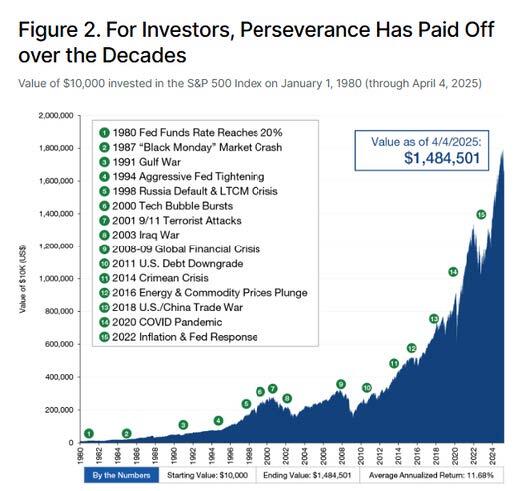
While market swings can feel dramatic in the moment, they’re not unusual. Historically, the U.S. stock market experiences a correction of 10% or more about every 1–2 years. Looking back to the 1980s, we see a consistent pattern: despite recessions, geopolitical crises, and sharp pullbacks, markets have tended to recover, and reward, long-term investors. While past performance isn’t predictive, history reinforces a core principle: staying invested is often the best way to benefit from eventual rebounds.
Source: Morningstar and Lord Abbett. The historical data are for illustrative purposes only, do not represent the performance of any specific portfolio managed by Lord Abbett or any particular investment, and are not intended to predict or depict future results. Indexes are unmanaged, do not reflect the deduction of fees or expenses, and are not available for direct investment. Past performance is not a reliable indicator or guarantee of future results.
The Role of Diversification
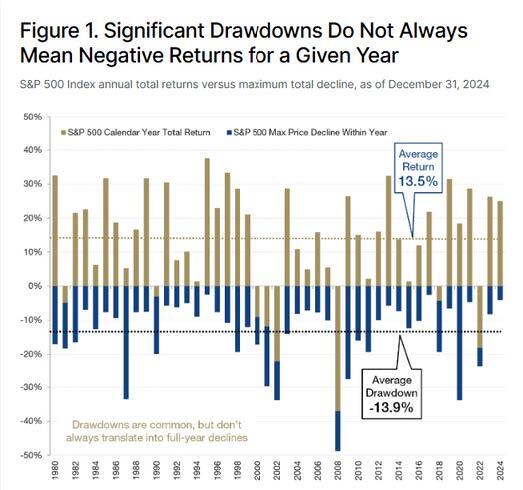
Diversification is one of the most effective tools for managing risk. By spreading investments across a range of asset classes, sectors, and geographies, a portfolio becomes better equipped to withstand volatility. A well-diversified portfolio won’t eliminate losses, but it can cushion the impact of market swings and reduce the likelihood of large drawdowns. This balance allows investors to stay focused on long-term goals, rather than reacting emotionally to short-term market movements.
Source: Morningstar and Lord Abbett. The historical data are for illustrative purposes only, do not represent the performance of any specific portfolio managed by Lord Abbett or any particular investment, and are not intended to predict or depict future results. Indexes are unmanaged, do not reflect the deduction of fees or expenses, and are not available for direct investment. Past performance is not a reliable indicator or guarantee of future results.
Why We Plan
Volatility is expected. That’s why we plan for it—not around it. A comprehensive financial plan provides a clear framework for decision-making, grounded in your goals and values. Our planning process considers:
Short-, medium-, and long-term goals
Financial and lifestyle priorities
Risk tolerance and investment preferences
Required portfolio income or growth
Timelines, tax exposure, and estate considerations
By building a personalized plan that reflects your “why,” we can better prepare for the inevitable ups and downs. We use stress-tested projections, conservative assumptions, and Monte Carlo simulations to model potential scenarios, including market declines, and tailor asset bucketing strategies to keep your plan on track.
The Psychology of Investing
Investor behavior plays a significant role in investment outcomes. Emotions, especially fear and euphoria, can lead to poor timing decisions, like selling in a downturn or chasing gains in a rally. That’s why we focus on three guiding principles: Control. Maintain. Remain.
Control
Focus on what you can influence: savings habits, spending, asset allocation, and your long-term goals. Accept that daily headlines and short-term market movements are beyond your control.
Maintain
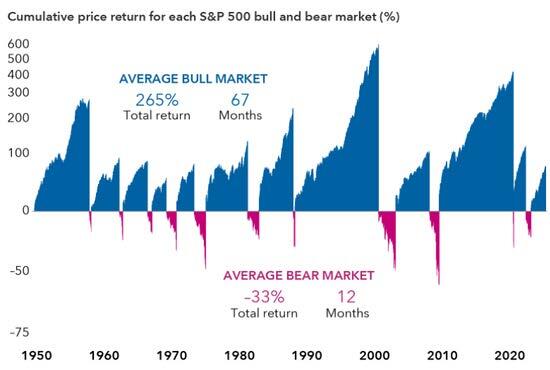
Maintain a long-term perspective. Historically, bear markets have lasted an average of 12 months, while bull markets have averaged nearly 67 months. Short-term corrections are part of the journey, not the destination.
Sources: Capital Group, RIMES, Standard & Poor's. As of December 31, 2024. The bull market that began in 2022 is considered current as of December 31, 2024, and is not included in the "average bull market" calculations. Bear markets are peak-to-trough price declines of 20% or more in the S&P 500, ending with a 50% recovery relative to the prior peak. Bull markets are all other periods. Returns shown on a logarithmic scale.
Remain
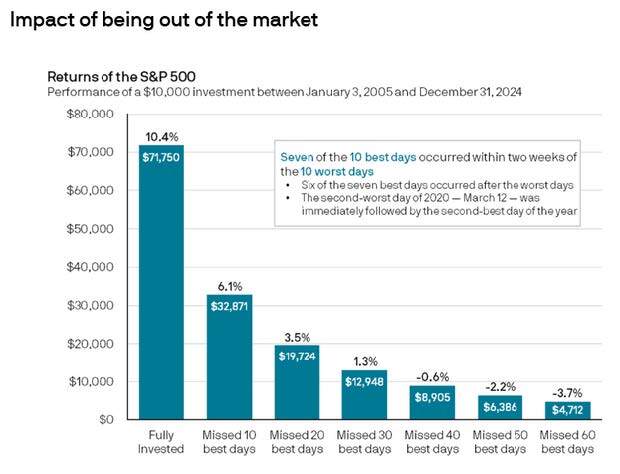
Stay invested. The cost of missing the market’s best days is steep. JP Morgan research shows that investors who missed just the 10 best days over the past 20 years saw their annual returns cut nearly in half. Often, the best days follow the worst—so timing the market can mean missing the rebound.
Source: JPMorgan
Seizing Opportunity in Volatility
Periods of market volatility don’t just carry risk, they also present opportunity. With the right plan and risk tolerance, these periods can be used strategically.
Entering the Market
Volatility creates entry points. Buying during market pullbacks can set the stage for long-term gains. For those with available cash or a long-term horizon, downturns can be an attractive buying opportunity.
Roth Conversions
Down markets may offer an opportune time to convert traditional retirement assets to Roth IRAs. When values are temporarily lower, the tax cost of conversion is reduced, and future growth can occur tax-free. This strategy can be especially valuable when paired with long-term planning around income levels and tax brackets.
Tax-Loss Harvesting
Selling investments at a loss to offset gains, while reinvesting in similar positions, can reduce taxable income and maintain market exposure. Losses can be used in the current year or carried forward for future tax years, helping enhance long-term after-tax returns.
Conclusion
Market volatility is inevitable, but it doesn’t have to derail your progress. History shows that staying disciplined, diversified, and focused on your long-term plan is the most reliable path to financial success.
Resonant Capital Advisors, LLC (“Resonant”) is an SEC registered investment adviser headquartered in Madison, Wisconsin. This paper is limited to the dissemination of general information for educational purposes only and, accordingly, should not be construed, in any manner whatsoever, as a substitute for personalized individual advice from Resonant.
Resonant has reasonable belief that this paper does not include any false or material misleading statements, omissions of fact or will otherwise result in any untrue or misleading implications regarding Resonant’s services, investments or client experiences. Although all information provided in this paper is gathered from sources deemed to be reliable, Resonant cannot guarantee the completeness or accuracy of such information and the information should not be regarded as a complete analysis of any subject discussed. This paper is based on information available as of the date of this communication. There is no guarantee that the information will remain current or complete in the future.
Resonant and its employees are not legal or tax advice experts. The information presented in this communication does not constitute investment, legal, tax or accounting advice. Always consult a financial advisor, attorney or tax professional regarding your specific investment, legal or tax situation. Investing involves risk, including the risk of loss, and past performance is not indicative of future performance.
For additional information about Resonant, please request our disclosure brochure as set forth on Form ADV or refer to the Investment Adviser Public Disclosure web site (www.adviserinfo.sec.gov). Please read the disclosure statement carefully. Resonant Capital Advisors, 33 East Main St, Suite 440 Madison WI 53703 (608) 733- 6220 .