Overview
Employee benefits are compensation packages in addition to wages that attract and retain employees. The benefits offered vary, as many provide insurance in the forms of medical, dental, and vision, along with access to employer-sponsored retirement plans.
When to Enroll
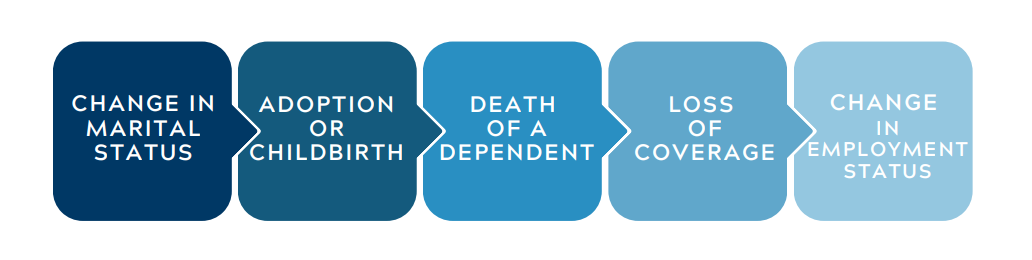
Employers allow employees to enroll during designated open enrollment periods. Besides these designated times, employees may elect to change their enrollment in the case of a qualifying life event. Qualifying life events include:
Insurance
Employer-sponsored insurance can include medical, dental, vision, disability, and life coverage. These plans, referred to as “group plans,” vary in their coverage and are established and maintained by the employer.
Healthcare Insurance
Healthcare benefits provide insurance or reimbursement for participants and their dependents. The most popular plans are Health Maintenance Organizations (HMO) and Preferred Provider Organizations (PPO) plans.
- Health Maintenance Organizations (HMO) Plans: HMO plans provide coverage for participants to use in-network providers, hospitals, and facilities. The narrow care option lowers premiums and lowers or removes deductibles paid by the plan participant.
- Preferred Provider Organizations (PPO) Plans: PPO plans offer more flexibility than HMO plans. Participants can seek medical care from both in and out-of-network providers without needing referrals or a primary care provider. By staying in-network, participants enjoy lower deductibles than out-of-network options.
High vs. Low Deductible Healthcare Plans
When choosing between high and low deductible healthcare plans, there are several pros and cons to consider:
High Deductible
- Pros: Lower Monthly Premiums & HSA Compatibility
- Cons: Higher Deductible & Higher Out-of-Pocket Costs
Low Deductible
- Pros: Lower Deductible & Lower Coinsurance
- Cons: No HSA Compatibility & Higher Premiums
Health Savings Account (HSA)
HSAs are savings accounts that let participants set aside pre-tax money for qualified medical expenses. They allow tax-free contributions, growth, and withdrawals for eligible expenses. Participants must be enrolled in a High Deductible Health Plan (HDHP) to contribute.
Flexible Savings Account (FSA)
FSAs are employer-sponsored accounts that let participants set aside a portion of their paychecks for specific out-of-pocket expenses, such as healthcare and dependent care costs. Contributions are tax-deductible, but funds must be used within the same year, making FSAs a "use it or lose it" benefit.
Dental & Vision Insurance
In addition to healthcare insurance, employers frequently provide dental and vision insurance for their employees. This coverage can be funded in various ways, including employer-paid premiums and the use of FSA funds.
Disability Insurance
Employer-sponsored disability benefits help protect participants and their families from financial hardships due to short-term or long-term disabilities.
- Short-Term (STD) & Long Term (LTD) Disability: STD and LTD plans differ in their coverage duration and timing. STD plans provide income replacement for up to the first year of a qualifying illness or injury. In contrast, LTD plans begin offering benefits only after the first year of disability.
- Taxation of Benefits: Taxation of benefits is dependent on who pays the premiums; employer paid premiums result in taxable benefits, employee paid premiums result in tax-free benefits.
Life Insurance
Employer-sponsored life insurance policies provide financial protection to a participant’s family in the event of their death, commonly a multiple of salary up to a specified limit.
Importantly: Employer-provided life and disability coverage is not portable, in certain circumstances a standalone policy may be needed.
Employer-Sponsored Retirement Plans
Among the benefits offered to employees, employer-sponsored retirement plans allow participants to save for retirement, often with an employer contribution.
- Employee Contribution: Employee contributions can be tax-deferred or Roth.
- Employer Match: Employers often contribute to employees' retirement plans by matching a portion of their contributions. The percentage matched, vesting schedules, and contribution limits can vary plan by plan.
Benefit Trends
As employers strive to attract and retain talent amid evolving legislation, available benefits have become more comprehensive.
- Roth Match: SECURE Act 2.0 allows employers to make matching contributions on a Roth basis, however this change must be actively implemented by the employer.
- Student Loan Assistance: For employees making qualified student loan payments, employers can assist with their payments in several ways:
- Direct payments from the employer on the principal of the employee’s student loan.
- SECURE Act 2.0 allows employers to make matching contributions to employer-sponsored retirement plans for employee loan payments.
- Employee Wellness Plans (EWP): In an effort to promote healthier lifestyles and offer more comprehensive benefits, employers are introducing EWPs that may include fitness memberships, cash rewards, and premium discounts.
Summary
With a wide range of benefits offered by employers, it's crucial to regularly review benefits and stay informed about benefit changes.
Resonant Capital Advisors, LLC (“Resonant”) is an SEC-registered investment adviser headquartered in Madison, Wisconsin. The information presented in this communication is limited to the dissemination of general information for educational purposes only. Accordingly, the information should not be construed, in any manner whatsoever, as investment, legal, tax or accounting advice related to individual situations. Always consult an attorney, tax or financial professional regarding your specific legal, tax or financial situation. This communication is not a solicitation or offer to sell securities, nor is it a recommendation to purchase a security. Although all information provided in this communication is gathered from sources deemed to be reliable, we cannot guarantee the completeness or accuracy of such information. The information should not be regarded as a complete analysis of any subject discussed herein.
For additional information about Resonant, please request our disclosure brochure as set forth on Form ADV or refer to the Investment Adviser Public Disclosure web site (www.adviserinfo.sec.gov). Please read the disclosure statement carefully.