Resonant Capital Advisors, LLC (“Resonant”) is a registered investment advisor. Information presented here is for educational purposes only and does not intend to make an offer or solicitation for the sale or purchase of any specific securities, investments, or investment strategies, nor should such information be construed as an opinion upon which any person may rely. The information provided here is of a general nature only and does not represent personal investment or tax advice, either express or implied. Resonant and its advisors are not tax experts. Because tax laws and regulations change frequently, and their application can vary widely based on the specific facts and circumstances involved, you should consult with a qualified tax professional before implementing any strategy discussed herein. To learn more about Wisconsin’s Edvest College Savings Plan, its investment objectives, tax benefits, risks and costs, please see the Plan Description at Edvest.com. Read it carefully. Investments in the Plan are neither insured nor guaranteed and there is the risk of investment loss. Consult your legal or tax professional for tax advice. If the funds aren’t used for qualified education higher expenses, a federal penalty tax on earnings (as well as federal and state income taxes) may apply.

Overview
529 plans, named for Section 529 of the Internal Revenue Code (IRC), are tax-advantaged savings plans designed to help pay qualified educational expenses. The definition of a “qualified educational expense” is broad, and may include tuition, certain room and board expenses as well as fees, books, supplies and required equipment (including computers and related technology such as internet access fees, software, and printers) used by a designated beneficiary when enrolled at an eligible educational institution. There is no limit on distributions from 529 plans to pay qualified educational expenses used post-high school. While 529 plans were originally created just for post-secondary education costs, recent legislation has expanded their flexibility in many ways, including for:
- K–12 Tuition - Up to $20,000 per year can be used tax-free for private or religious elementary and secondary school tuition.
- Apprenticeship Programs - Funds can be used for expenses tied to registered apprenticeship programs.
- Student Loan Repayment - A lifetime maximum of $10,000 can be withdrawn to repay qualified student loans for the beneficiary and each of their siblings.
- Roth IRA Rollover - Up to $35,000 (lifetime limit) may be rolled over from a 529 plan to a Roth IRA for the same beneficiary, provided the following requirements are met:
- The 529 account has been open for at least 15 years.
- Contributions (and earnings on those contributions) made within the past 5 years are not eligible for rollover.
- The beneficiary must have earned income, and annual Roth IRA contribution limits still apply.
529 plan access may also be provided by financial services firms and their advisors, and plan assets may be moved between custodians without sacrificing tax advantages. Transfers between plans are commonly referred to as “rollovers.” 529 plans include both savings and prepaid-tuition plans, but we focus here on savings plans as they are more widely-used.
Structure & Advantages
529 plans are contributed to by account holders, who choose the account’s beneficiaries as well as the account’s investments. There is no federal income tax benefit for 529 plan contributions, but there are a number of tax advantages to 529 plans. They include:
- Some states provide a tax benefit to account holders for 529 plan contributions.
- Wisconsin allows a maximum state income tax deduction of $5,280 per year, per beneficiary, and the principal portion of incoming withdrawals from other states’ plans qualifies as a contribution eligible for a Wisconsin state tax deduction for in-state taxpayers;
- Contributions greater than the maximum may be carried forward and used in future tax years;
- Earnings on 529 plan contributions grow, and may be withdrawn for qualified education expenses, tax-free, and;
- There is no federal gift tax on contributions up to $19,000/$38,000 (single/married filers, respectively) for contributions made under the annual gift tax exclusion. Larger one-time gifts of $95,000/$190,000 may be made and pro-rated over a 5-year period for Federal gift tax exclusion purposes.
Preparing For the Future
College education expenses have continued to rise steadily over time, increasing at a pace well above most other household expenses. In fact, college costs have grown at an average annual rate of approximately 5.5%.¹ Looking ahead, the chart below illustrates projected four-year college education costs based on a child’s current age.
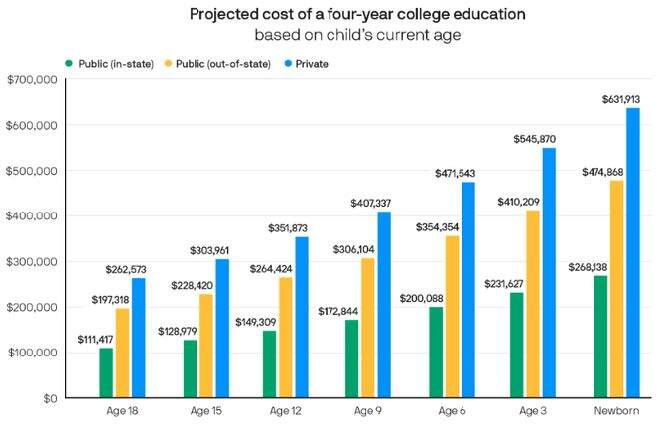
¹Source: JPM College Planning Essentials. Assumes one-year costs for 2025-2026 at $25,850 public (in-state), $45,780 public
(out-of-state), and $60,920 (private)
Starting Early
The earlier you begin investing, the more time your child’s college savings have to benefit from ongoing contributions and long-term compounding growth. The chart below illustrates how even modest monthly contributions made early on can grow significantly over time.
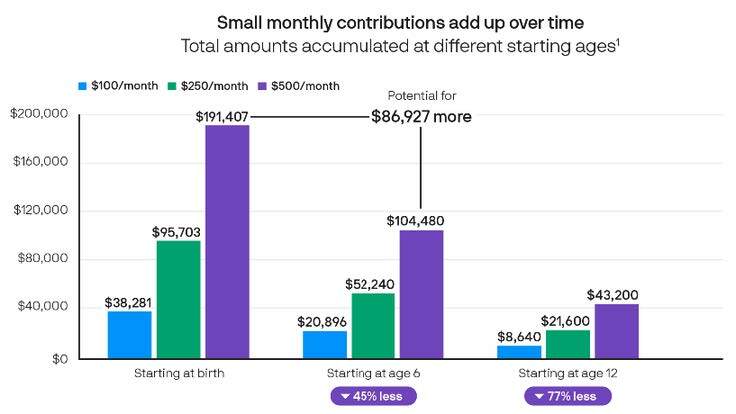
Source: JPM College Planning Essentials.
Summary
529 plans offer families a flexible and tax-efficient way to save for future education costs while supporting long-term financial goals. By integrating these plans into a comprehensive financial strategy, investors can empower the next generation with greater access to education and reduced reliance on debt.